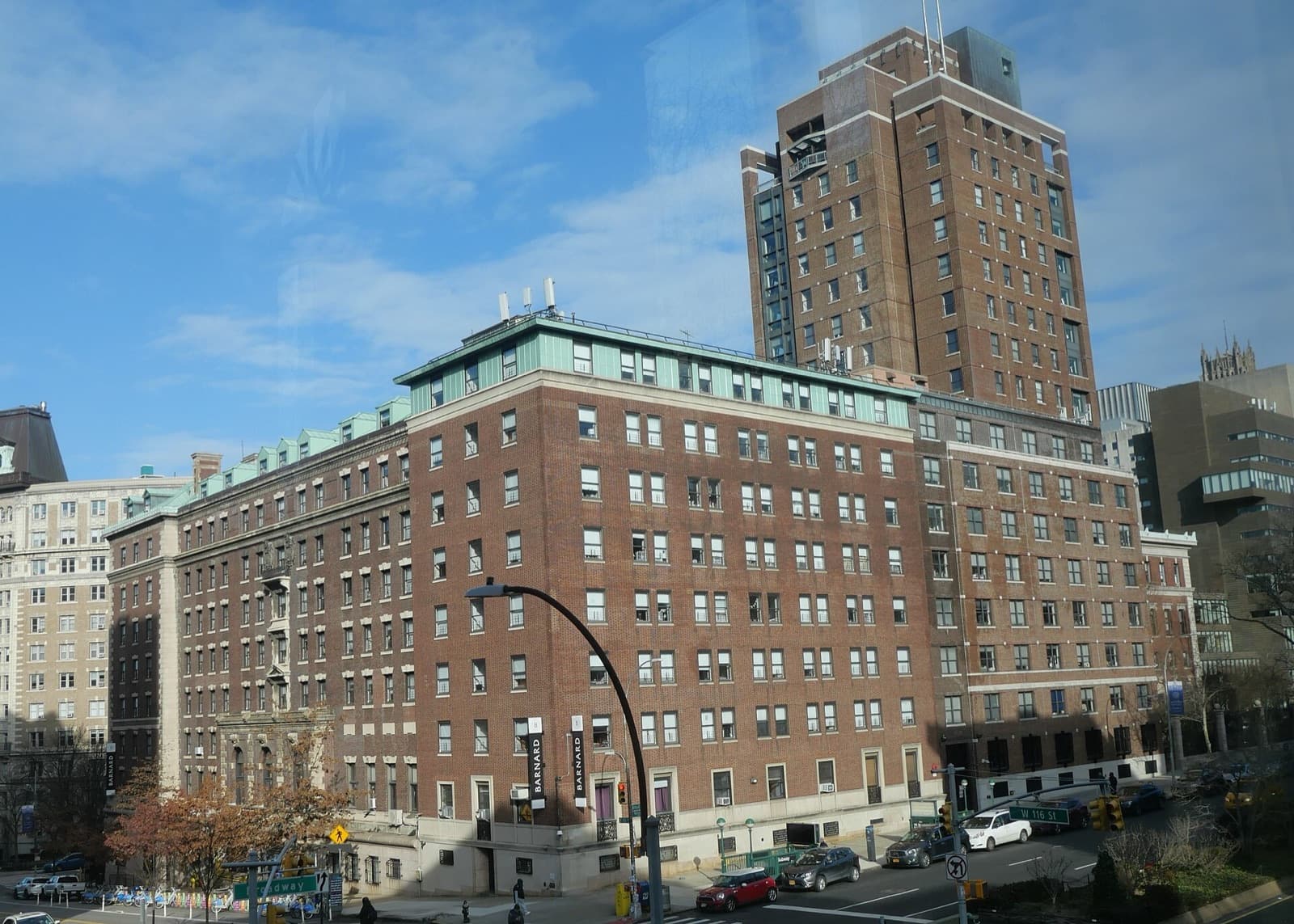

Barnard College
Barnard College is a private women's liberal arts college in New York City's Morningside Heights, founded in 1889 and partnered with Columbia University, whose courses, libraries, and degrees its students share. Admission is highly selective — Barnard admitted about 10% of roughly 10,430 applicants for its most recent class, and enrolled first-years posted middle-50% SAT scores of 1480–1540 and ACT scores of 32–35. The social sciences are the most-conferred field at roughly a quarter of bachelor's degrees, followed by the biological sciences and interdisciplinary studies. Barnard is test-optional and meets 100% of demonstrated financial need, with a typical need-based package near $73,500 for first-year students.
See how Barnard compares
Pick up to two rivals — or search any school.
Barnard admissions statistics
Acceptance rate
Total applicants, admitted students, and enrolled students for the most recent admission cycle.
Early decision
Barnard offers binding Early Decision. Applying early can meaningfully change your odds — but ED commits you to enroll if admitted.
Admit rate by application plan
% admitted~5.2× higher admit rate applying early.
Standardized tests
Barnard is currently test-optional — you may apply without submitting scores.
SAT Accepted?
ACT Accepted?
Test Optional?
SAT Scores
ACT Scores
Barnard supplemental essays — 2026-2027 cycle
At Barnard, inquiry starts with asking bold questions about the world. What is one bold question on your mind and what about it piques your curiosity?
Barnard College is shaped by trailblazing women with a multitude of perspectives. Think of a woman - historical, fictional, contemporary, or personally significant - whose views or approach to problem-solving differ from your own, but who excels at bringing people together. What lesson from her approach would shape how you show up at Barnard both inside and outside of the classroom?
Writing your Barnard application essay?
Paste your draft and get specific, line-by-line feedback on what is and isn't landing — scored against the rubrics admissions readers use.
Admissions factors
How Barnard weighs each part of your application.
Rigor of High School Record
Academic GPA
Standardized Test Scores
Application Essay
Recommendations
Extracurricular Activities
Character / Personal Qualities
Talent / Ability
First Generation
Level of Applicant's Interest
Class Rank
Volunteer Work
Work Experience
Geographical Residence
State Residency
Alumni Relation
Racial / Ethnic Status
Religious Affiliation
Cost of attendance
Estimated full-time annual cost from Barnard's Common Data Set.
Private universities charge the same tuition regardless of state residency.
What families actually pay
Average net price — what was left to pay after grant aid — for students receiving federal financial aid.
Source: College Scorecard (2026)
Financial aid
Need-based aid statistics for full-time first-year students.
Frequently asked questions about Barnard admissions
Yes — Barnard is highly selective, admitting about 10% of applicants in the most recent cycle, roughly 1,048 offers out of about 10,430 applications. Admitted students are concentrated near the top of their class: enrolled first-years posted middle-50% SAT scores of 1480-1540 and ACT scores of 32-35.
Yes — Barnard is a women's liberal arts college, and all of its roughly 3,220 degree-seeking undergraduates are women. It is located in New York City's Morningside Heights, and it shares Columbia University's courses, libraries, and degrees through their longstanding partnership.
Yes, Barnard's binding Early Decision round admits at a noticeably higher rate than the overall pool. Of 1,437 Early Decision applicants, 476 were admitted, an Early Decision rate of about 33%, well above the roughly 10% overall acceptance rate. Because ED is binding, you commit to enrolling if admitted.
Barnard doesn't publish a minimum GPA or class-rank cutoff, and for its most recent class it reported neither an average GPA nor a class-rank distribution. Review is holistic: the college weighs the rigor of your high school course load and your academic GPA as very important, with class rank treated as important. Strong grades in a demanding program count most, since only about 10% of applicants are admitted.
Barnard is test-optional, so you can apply without submitting SAT or ACT scores. Among enrolled students who did submit, the middle 50% scored 1480-1540 on the SAT and 32-35 on the ACT, with about 99% of SAT submitters scoring 1400 or higher, so a submitted score generally helps most when it lands in or above that range.
Barnard is an independent women's college partnered with Columbia University in Morningside Heights, and Barnard students take Columbia courses, use its libraries, and earn a degree affiliated with Columbia. Barnard runs its own admissions and is highly selective in its own right, admitting about 10% of roughly 10,430 applicants.
Tuition and required fees are about $75,592 per year, with the total cost of attendance higher once on-campus housing and food (around $23,258) are added. Barnard meets 100% of demonstrated financial need; roughly 37% of first-years receive need-based grant or scholarship aid, with an average need-based package near $73,503.
Yes — Barnard rates the application essay as a very important factor in its holistic review, on par with GPA, rigor of coursework, recommendations, and personal character, and above standardized test scores, which are only considered. With an acceptance rate near 10%, a specific, well-revised essay is one of the clearest ways a strong applicant can stand out.
Esslo gives free line-by-line feedback on your draft. Try it now
Popular majors
Bachelor's degrees awarded in the past year by academic major.
Student-faculty ratio
The number of students for every one faculty member, indicating the average level of access students have to instructional staff.
Student outcomes
Median yearly income of former students who received federal aid, across every major, measured four years after graduating (2017–18 and 2018–19 graduates, earnings measured 2022–2023). Debt covers federal loans of students who completed.
Source: College Scorecard (2026)
Programs
Barnard’s most popular programs and median pay after graduation. Income data from the US Department of Education’s College Scorecard.
- Economics
91 degrees (2023-24)
~$112kmedian pay, 4 yrs after graduation~$16k median debt - Neuroscience
68 degrees (2023-24)
~$67kmedian pay, 4 yrs after graduation~$17k median debt - Computer Science
61 degrees (2023-24)
Not publishedmedian pay after graduation - Political Science
61 degrees (2023-24)
~$78kmedian pay, 4 yrs after graduation~$18k median debt - English
48 degrees (2023-24)
~$61kmedian pay, 4 yrs after graduation~$19k median debt
Show all 20 programsShow fewer
- History
29 degrees (2023-24)
~$62kmedian pay, 4 yrs after graduation~$16k median debt - Area Studies
27 degrees (2023-24)
~$66kmedian pay, 4 yrs after graduation~$19k median debt - Fine & Studio Arts
25 degrees (2023-24)
~$40kmedian pay, 1 yr after graduation~$19k median debt - Biology
19 degrees (2023-24)
~$76kmedian pay, 4 yrs after graduation~$18k median debt - Architecture
14 degrees (2023-24)
Not publishedmedian pay after graduation - Biochemistry & Molecular Biology
13 degrees (2023-24)
Not publishedmedian pay after graduation - Chemistry
8 degrees (2023-24)
Not publishedmedian pay after graduation - Mathematics
7 degrees (2023-24)
Not publishedmedian pay after graduation - Linguistics & Language Studies
7 degrees (2023-24)
Not publishedmedian pay after graduation - Philosophy
7 degrees (2023-24)
Not publishedmedian pay after graduation - Physics
7 degrees (2023-24)
Not publishedmedian pay after graduation - Education
5 degrees (2023-24)
Not publishedmedian pay after graduation - Environmental Science & Natural Resources
4 degrees (2023-24)
~$43kmedian pay, 1 yr after graduation - Music
3 degrees (2023-24)
Not publishedmedian pay after graduation - Computer & Information Sciences
Degrees conferred not published (2023-24)
~$107kmedian pay, 1 yr after graduation~$19k median debt
Median pay data is measured from graduates who received federal student aid.
Source: College Scorecard (2026) · IPEDS (2023-24)
Campus life
On-campus housing and Greek life participation rates.
Place
How the federal government classifies the area around the campus, and what a normal year of weather looks like there.
Average temperature
Monthly high and low, °FThirty-year averages, measured at the nearest weather station rather than on campus — they describe the area, not the campus.
Source: IPEDS (HD2024) · NOAA 1991–2020 U.S. Climate Normals, NEW YORK CNTRL PK TWR, NY US station, 2.2 mi from campus
Enrollment by gender
Student diversity
Racial and ethnic breakdown of enrolled undergraduate students.
Source: Barnard College Common Data Set 2025-2026. Figures transcribed 2026-06-25. Esslo aggregates publicly reported data and is not affiliated with Barnard. Banner photo by Jim.henderson, via Wikimedia Commons (CC BY 4.0). Cite this page as: Esslo College Explorer, “Barnard College admissions statistics, transcribed from the 2025-2026 Common Data Set,” https://www.esslo.org/colleges/barnard (retrieved 2026-06-25).