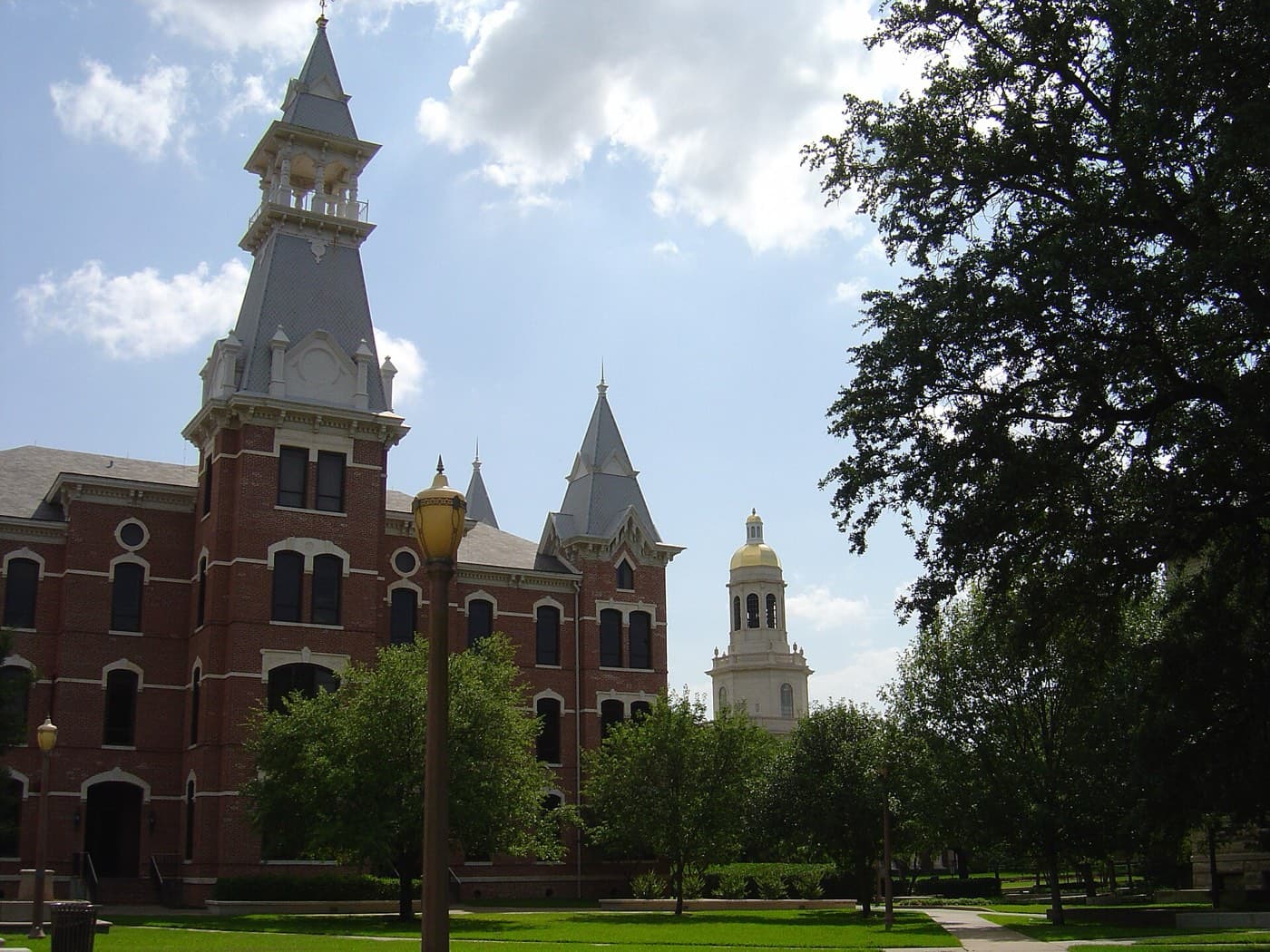

Baylor University
Baylor University is a private Christian research university in Waco, Texas, affiliated with the Baptist faith and the largest Baptist university in the world. It earned the Carnegie R1 "very high research" classification while keeping a strong undergraduate focus on business, nursing, and pre-health programs. Baylor admitted about 52% of its roughly 45,000 applicants for the most recent class, and enrolled first-years posted middle-50% SAT scores of 1190–1370 (26–32 ACT). Business is the most-conferred field at about 24% of bachelor's degrees, followed by the health professions, and 98% of first-years live on campus.
See how Baylor compares
Pick up to two rivals — or search any school.
Baylor admissions statistics
Acceptance rate
Total applicants, admitted students, and enrolled students for the most recent admission cycle.
Early decision
Baylor offers binding Early Decision. Applying early can meaningfully change your odds — but ED commits you to enroll if admitted.
Admit rate by application plan
% admitted~1.5× higher admit rate applying early.
Standardized tests
Baylor is currently test-optional — you may apply without submitting scores.
SAT Accepted?
ACT Accepted?
Test Optional?
SAT Scores
ACT Scores
Baylor application deadlines — Fall 2027
Last checked August 19, 2026. If you are applying, you should verify deadlines on Baylor’s site.
- Early DecisionNovember 1, 2026
- Early ActionNovember 1, 2026
- Regular DecisionFebruary 1, 2027
Source: Baylor’s admissions dates page · checked August 19, 2026
Baylor supplemental essays — 2026-2027 cycle
What are you looking for in a university, why do you want to attend Baylor, and how do you see yourself contributing to the Baylor community?
Writing your Baylor application essay?
Paste your draft and get specific, line-by-line feedback on what is and isn't landing — scored against the rubrics admissions readers use.
Class rank
Where Baylor's enrolled first-years placed in their high school graduating class.
Based on the 49% of enrolled students who reported a class rank. Baylor does not publish an average GPA.
Admissions factors
How Baylor weighs each part of your application.
Rigor of High School Record
Academic GPA
Standardized Test Scores
Application Essay
Recommendations
Extracurricular Activities
Character / Personal Qualities
Talent / Ability
First Generation
Level of Applicant's Interest
Class Rank
Volunteer Work
Work Experience
Geographical Residence
State Residency
Alumni Relation
Racial / Ethnic Status
Religious Affiliation
Cost of attendance
Estimated full-time annual cost from Baylor's Common Data Set.
Private universities charge the same tuition regardless of state residency.
What families actually pay
Average net price — what was left to pay after grant aid — for students receiving federal financial aid.
Source: College Scorecard (2026)
Financial aid
Need-based aid statistics for full-time first-year students.
Frequently asked questions about Baylor admissions
Baylor is moderately selective, admitting about 52.2% of its roughly 45,000 applicants in the most recent cycle. Enrolled first-years posted middle-50% SAT scores of 1190–1370 and 26–32 on the ACT, and among the 49% who reported a class rank, 76% sat in the top quarter of their graduating class. Strong grades in a solid course load matter most, since Baylor weighs academic GPA and test scores as very important.
Aim for the middle-50% range: enrolled first-years scored 1190–1370 on the SAT and 26–32 on the ACT. A score above 1370 or 32 puts you in the top quarter of admitted students. Baylor is test-optional, so you can apply without scores, but when submitted they count as a very important factor.
A 1300 is competitive at Baylor. It lands in the upper-middle of the admitted range, above the median of 1280 and on track toward the 75th-percentile mark of 1370. Pairing it with a strong GPA and a specific essay makes for a solid application, since Baylor reviews holistically rather than against a hard score cutoff.
No. Baylor is test-optional, so you choose whether to send SAT or ACT scores. About 47% of enrolled first-years submitted the SAT and 22% the ACT. Home-schooled students, applicants from high schools that issue only narrative transcripts, and a few specific majors still need to submit scores, so check your program's requirements.
Baylor's binding Early Decision round admits at a higher rate than the overall 52.2%: about 453 admits from 566 Early Decision applications, or roughly 80%. ED is a binding commitment, so apply that way only if Baylor is your clear first choice. Baylor also offers non-binding Early Action with a November 1 deadline for students who want an early answer without the commitment.
Tuition and fees run about $67,756 a year, with food and housing adding roughly $17,222. Aid is substantial: about 56% of first-year students receive need-based scholarship or grant aid, the average need-based package is near $44,891, and Baylor meets about 71% of demonstrated financial need on average.
Business and marketing is the largest field at about 24% of bachelor's degrees, followed by the health professions at roughly 20% and the biological and life sciences at about 11%. Communication and journalism, the social sciences, and psychology round out the most-conferred areas, reflecting Baylor's deep pre-business and pre-health pipelines.
Yes. Baylor rates the application essay as an important factor in its holistic review, alongside the rigor of your high school record. Academic GPA and test scores carry the most weight, so a specific, well-revised essay is where you add the personal context and voice that grades and scores can't show.
Esslo gives free line-by-line feedback on your draft. Try it now
Popular majors
Bachelor's degrees awarded in the past year by academic major.
Student-faculty ratio
The number of students for every one faculty member, indicating the average level of access students have to instructional staff.
Student outcomes
Median yearly income of former students who received federal aid, across every major, measured four years after graduating (2017–18 and 2018–19 graduates, earnings measured 2022–2023). Debt covers federal loans of students who completed.
Source: College Scorecard (2026)
Programs
Baylor’s most popular programs and median pay after graduation. Income data from the US Department of Education’s College Scorecard.
- Nursing
330 degrees (2023-24)
~$90kmedian pay, 4 yrs after graduation~$22k median debt - Biology
217 degrees (2023-24)
~$57kmedian pay, 4 yrs after graduation~$23k median debt - Communication & Media Studies
208 degrees (2023-24)
~$59kmedian pay, 4 yrs after graduation~$23k median debt - Finance
181 degrees (2023-24)
~$103kmedian pay, 4 yrs after graduation~$22k median debt - Psychology
156 degrees (2023-24)
~$65kmedian pay, 4 yrs after graduation~$25k median debt
Show all 32 programsShow fewer
- Political Science
117 degrees (2023-24)
~$62kmedian pay, 4 yrs after graduation~$25k median debt - Kinesiology & Exercise Science
112 degrees (2023-24)
~$51kmedian pay, 4 yrs after graduation~$25k median debt - Business Administration & Management
89 degrees (2023-24)
~$86kmedian pay, 4 yrs after graduation~$22k median debt - Neuroscience
81 degrees (2023-24)
~$54kmedian pay, 4 yrs after graduation~$27k median debt - Biochemistry & Molecular Biology
65 degrees (2023-24)
~$50kmedian pay, 4 yrs after graduation~$27k median debt - Mechanical EngineeringABET accreditedMechanical Engineering is accredited by ABET, the accreditor for engineering, computing, and applied science programs.
56 degrees (2023-24)
~$93kmedian pay, 4 yrs after graduation~$26k median debt - Journalism
53 degrees (2023-24)
~$64kmedian pay, 4 yrs after graduation~$24k median debt - Human Development & Family Studies
44 degrees (2023-24)
~$47kmedian pay, 4 yrs after graduation~$20k median debt - Environmental Science & Natural Resources
42 degrees (2023-24)
~$60kmedian pay, 4 yrs after graduation~$26k median debt - Economics
42 degrees (2023-24)
Not publishedmedian pay after graduation - History
40 degrees (2023-24)
~$57kmedian pay, 4 yrs after graduation~$25k median debt - Public Health
38 degrees (2023-24)
~$23kmedian pay, 1 yr after graduation~$22k median debt - Music
35 degrees (2023-24)
~$40kmedian pay, 4 yrs after graduation~$27k median debt - Fine & Studio Arts
33 degrees (2023-24)
~$50kmedian pay, 4 yrs after graduation~$26k median debt - Computer ScienceABET accreditedComputer Science is accredited by ABET, the accreditor for engineering, computing, and applied science programs.
26 degrees (2023-24)
~$128kmedian pay, 4 yrs after graduation~$27k median debt - English
21 degrees (2023-24)
~$54kmedian pay, 4 yrs after graduation - General EngineeringABET accreditedEngineering is accredited by ABET, the accreditor for engineering, computing, and applied science programs.
17 degrees (2023-24)
~$85kmedian pay, 4 yrs after graduation - Data Science
16 degrees (2023-24)
Not publishedmedian pay after graduation - Chemistry
15 degrees (2023-24)
~$65kmedian pay, 4 yrs after graduation~$27k median debt - Philosophy
14 degrees (2023-24)
Not publishedmedian pay after graduation - Mathematics
13 degrees (2023-24)
~$90kmedian pay, 4 yrs after graduation~$25k median debt - Earth & Geological Sciences
7 degrees (2023-24)
Not publishedmedian pay after graduation - Linguistics & Language Studies
4 degrees (2023-24)
Not publishedmedian pay after graduation - Area Studies
3 degrees (2023-24)
Not publishedmedian pay after graduation - Physics
1 degrees (2023-24)
Not publishedmedian pay after graduation - Computer EngineeringABET accreditedElectrical and Computer Engineering is accredited by ABET, the accreditor for engineering, computing, and applied science programs.
Degrees conferred not published (2023-24)
Not publishedmedian pay after graduation - Electrical EngineeringABET accreditedElectrical and Computer Engineering is accredited by ABET, the accreditor for engineering, computing, and applied science programs.
Degrees conferred not published (2023-24)
~$100kmedian pay, 4 yrs after graduation~$22k median debt
Median pay data is measured from graduates who received federal student aid.
Source: College Scorecard (2026) · IPEDS (2023-24) · ABET
Campus life
On-campus housing and Greek life participation rates.
Place
How the federal government classifies the area around the campus, and what a normal year of weather looks like there.
Average temperature
Monthly high and low, °FThirty-year averages, measured at the nearest weather station rather than on campus — they describe the area, not the campus.
Source: IPEDS (HD2024) · NOAA 1991–2020 U.S. Climate Normals, WACO DAM, TX US station, 6.7 mi from campus
Enrollment by gender
Student diversity
Racial and ethnic breakdown of enrolled undergraduate students.
Source: Baylor University Common Data Set 2025-2026. Figures transcribed 2026-06-10. Esslo aggregates publicly reported data and is not affiliated with Baylor. Banner photo by W>Aboxorocks, via Wikimedia Commons (CC BY-SA 3.0). Cite this page as: Esslo College Explorer, “Baylor University admissions statistics, transcribed from the 2025-2026 Common Data Set,” https://www.esslo.org/colleges/baylor (retrieved 2026-06-10).