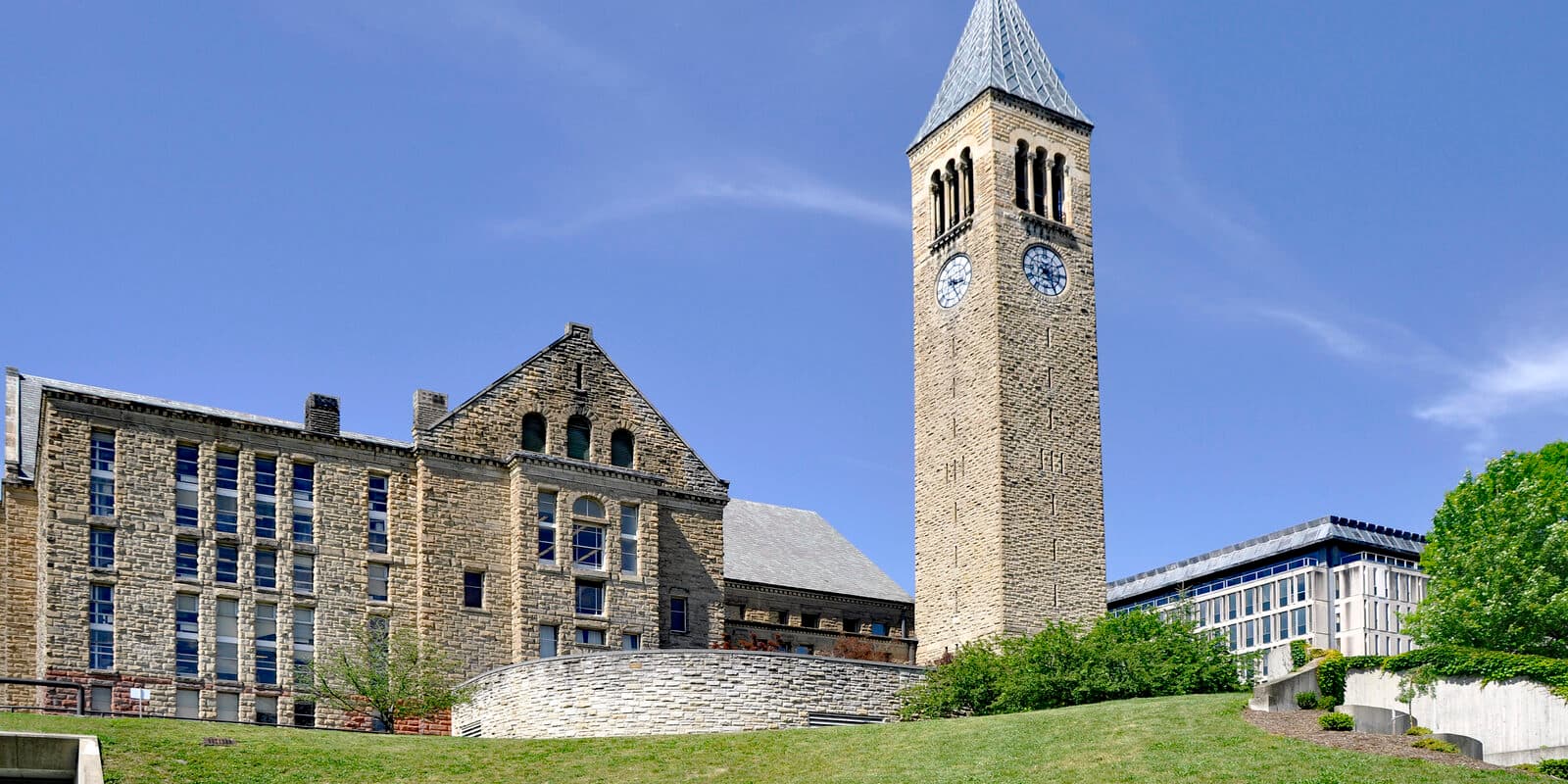

Cornell University
Cornell University is a private Ivy League research university in Ithaca, New York, and the largest of the Ivies, enrolling roughly 16,138 undergraduates across colleges as varied as engineering, agriculture and life sciences, architecture, and hotel administration. Admission is highly competitive — Cornell admitted about 8.4% of more than 72,000 applicants for its most recent class, which carried middle-50% SAT scores of 1490–1550 and an ACT range of 33–35. Cornell's most recent class applied test-optional, though the university is reinstating an SAT/ACT requirement for future applicants, and it meets 100% of demonstrated financial need. The figures below are drawn directly from Cornell's official Common Data Set.
See how Cornell compares
Pick up to two rivals — or search any school.
Cornell admissions statistics
Acceptance rate
Total applicants, admitted students, and enrolled students for the most recent admission cycle.
Early decision
Cornell offers binding Early Decision. Applying early can meaningfully change your odds — but ED commits you to enroll if admitted.
Admit rate by application plan
% admitted~2.8× higher admit rate applying early.
Standardized tests
Cornell is currently test-optional — you may apply without submitting scores.
SAT Accepted?
ACT Accepted?
Test Optional?
SAT Scores
ACT Scores
Cornell application deadlines — Fall 2027
Last checked August 19, 2026. If you are applying, you should verify deadlines on Cornell’s site.
- Early DecisionNovember 1, 2026
- Regular DecisionJanuary 2, 2027
Source: Cornell’s admissions dates page · checked August 19, 2026
Cornell supplemental essays — 2026-2027 cycle
By applying to Cornell's College of Agriculture and Life Sciences (CALS), you are also applying directly to one of our majors. From here, you would be part of a community dedicated to purpose-driven science; working within your major and across disciplines to tackle complex, real-world challenges.
What interests you about the major you selected? Tell us about experiences (both in and outside of the classroom), questions, and goals that influenced your choice.
What draws you to Cornell's College of Agriculture and Life Sciences (CALS)? Reflect on the learning, community, or impact opportunities that matter most to you, and share how they align with Cornell CALS (as you understand it currently).
How do your interests directly connect with your intended major at the College of Architecture, Art and Planning (AAP)? B.Arch applicants, please provide an example of how a creative project or passion sparks your motivation to pursue a 5-year professional degree program.
How do your interests directly connect with your intended major at the College of Architecture, Art and Planning (AAP)? BFA applicants, you may want to consider how you could integrate a range of interests and available resources at Cornell into a coherent art practice.
How do your interests directly connect with your intended major at the College of Architecture, Art and Planning (AAP)? URS students, you may want to emphasize your enthusiasm and depth of interest in the study of urban and regional issues.
At the College of Arts & Sciences, your education is yours to shape. Describe an intellectual passion, question, or idea that has captured your attention – whether it emerges from your studies or extends beyond your coursework. What specific aspects of our liberal arts curriculum would you draw on to explore and connect your varied interests?
Discuss your interest in pursuing a major in policy at the Cornell Jeb E. Brooks School of Public Policy and what draws you to this field of study. You are encouraged to consider including details related to your personal experiences, values, academic influences, or extracurricular activities that have shaped your perspective and future goals.
Discuss your interest in pursuing a major in policy at the Cornell Jeb E. Brooks School of Public Policy and what draws you to this field of study. You are encouraged to consider including details related to your personal experiences, values, academic influences, or extracurricular activities that have shaped your perspective and future goals.
Please describe why you are interested in being considered for the Brooks School DC Start program.
What kind of business student are you? Using your personal, academic, or volunteer/work experiences, describe the topics or issues that you care about and why they are important to you. Your response should convey how your interests align with the school to which you are applying within the Cornell SC Johnson College of Business (the Charles H. Dyson School of Applied Economics and Management or the Cornell Peter and Stephanie Nolan School of Hotel Administration).
Fundamentally, engineering is the application of math, science, and technology to solve complex problems. Why do you want to study engineering?
Why do you think you would love to study at Cornell Duffield Engineering?
What brings you joy?
What do you believe you will contribute to the Cornell Duffield Engineering community beyond what you've already detailed in your application? What unique voice will you bring?
What is one activity, club, team, organization, work/volunteer experience or family responsibility that is especially meaningful to you? Please briefly tell us about its significance for you.
What is one award you have received or achievement you have attained that has meant the most to you? Please briefly describe its importance to you.
The College of Human Ecology prepares students to respond to human needs through an education organized around the interconnected issues that profoundly affect individuals, communities, and the institutions that shape our lives.
Think about an extracurricular/community engagement/work experience that most closely connects you to the CHE mission and your intended choice of major. Tell us what that experience taught you about your broader community and its needs, and the impact you can make. How will your intended CHE major help you make that impact?
Using your personal, academic, or volunteer/work experiences, describe the topics or issues that you care about and why they are important to you. Your response should show us that your interests align with the ILR School.
Writing your Cornell application essay?
Paste your draft and get specific, line-by-line feedback on what is and isn't landing — scored against the rubrics admissions readers use.
Class rank
Where Cornell's enrolled first-years placed in their high school graduating class.
Based on the 12.2% of enrolled students who reported a class rank. Cornell does not publish an average GPA.
Admissions factors
How Cornell weighs each part of your application.
Rigor of High School Record
Academic GPA
Standardized Test Scores
Application Essay
Recommendations
Extracurricular Activities
Character / Personal Qualities
Talent / Ability
First Generation
Level of Applicant's Interest
Class Rank
Volunteer Work
Work Experience
Geographical Residence
State Residency
Alumni Relation
Racial / Ethnic Status
Religious Affiliation
Cost of attendance
Estimated full-time annual cost from Cornell's Common Data Set.
Private universities charge the same tuition regardless of state residency.
What families actually pay
Average net price — what was left to pay after grant aid — for students receiving federal financial aid.
Source: College Scorecard (2026)
Financial aid
Need-based aid statistics for full-time first-year students.
Frequently asked questions about Cornell admissions
Yes — Cornell is highly selective, admitting about 8.4% of applicants in the most recent cycle, offering admission to roughly 6,077 of more than 72,000 applicants. Admitted students cluster at the very top academically, with middle-50% SAT scores of 1490–1550 and ACT scores of 33–35, and about 84% of those who reported a class rank stood in the top tenth of their graduating class.
Cornell's binding Early Decision round is meaningfully less selective than the overall pool: it admitted about 1,889 of 10,057 ED applicants in the most recent cycle, an ED rate near 18.8% versus the 8.4% overall acceptance rate. Cornell offers Early Decision (not Early Action), so applying ED is a binding commitment to enroll if admitted.
Cornell's most recent published class applied under a test-optional policy, and among enrolled students who submitted scores the middle 50% scored 1490–1550 on the SAT and 33–35 on the ACT. Cornell is reinstating a standardized testing requirement for future applicants, so confirm the policy that applies to your cycle on its admissions site.
A 1550 is competitive — it sits right at the top of the middle 50% of enrolled first-years, who scored 1490–1550 on the SAT (33–35 ACT), matching the 75th-percentile mark of 1550. About 93% of score-submitting enrolled students scored 1400 or above, so a 1550 puts you comfortably in range, though scores are only one of many factors Cornell weighs.
Cornell does not publish an average GPA in its Common Data Set, but admitted students sit at the top of their class: among those who reported a rank, about 84% were in the top tenth and roughly 97% in the top quarter of their graduating class. The rigor of your high school coursework is weighed as a very important factor alongside your academic record.
Tuition and required fees run about $74,970 per year before food and housing. Cornell meets 100% of demonstrated financial need: about 44% of first-years receive need-based scholarship or grant aid, and the average need-based aid package is roughly $68,147.
Computer science is the single most popular field at about 19% of bachelor's degrees, followed by engineering (15%) and business and marketing (11%). Cornell's land-grant heritage also makes agriculture (about 11%) and the biological sciences (about 10%) unusually strong for an Ivy.
Yes — Cornell rates the application essay as a very important factor in its holistic review, on par with recommendations, extracurricular activities, and character, and above standardized test scores, which are only considered. With an 8.4% acceptance rate, a specific, well-revised essay is one of the clearest ways a strong applicant can stand out.
Esslo gives free line-by-line feedback on your draft. Try it now
Popular majors
Bachelor's degrees awarded in the past year by academic major.
Student-faculty ratio
The number of students for every one faculty member, indicating the average level of access students have to instructional staff.
Student outcomes
Median yearly income of former students who received federal aid, across every major, measured four years after graduating (2017–18 and 2018–19 graduates, earnings measured 2022–2023). Debt covers federal loans of students who completed.
Source: College Scorecard (2026)
Programs
Cornell’s most popular programs and median pay after graduation. Income data from the US Department of Education’s College Scorecard.
- Computer Science
467 degrees (2023-24)
~$223kmedian pay, 4 yrs after graduation~$15k median debt - Biology
264 degrees (2023-24)
~$69kmedian pay, 4 yrs after graduation~$16k median debt - Agricultural Business
243 degrees (2023-24)
~$145kmedian pay, 4 yrs after graduation~$13k median debt - Computer & Information Sciences
226 degrees (2023-24)
~$144kmedian pay, 4 yrs after graduation~$16k median debt - Mechanical EngineeringABET accreditedMechanical Engineering is accredited by ABET, the accreditor for engineering, computing, and applied science programs.
152 degrees (2023-24)
~$112kmedian pay, 4 yrs after graduation~$16k median debt
Show all 30 programsShow fewer
- Economics
145 degrees (2023-24)
~$138kmedian pay, 4 yrs after graduation~$15k median debt - Political Science
106 degrees (2023-24)
~$95kmedian pay, 4 yrs after graduation~$14k median debt - Environmental Science & Natural Resources
95 degrees (2023-24)
~$68kmedian pay, 4 yrs after graduation~$16k median debt - Communication & Media Studies
75 degrees (2023-24)
~$88kmedian pay, 4 yrs after graduation~$14k median debt - Public Policy
74 degrees (2023-24)
~$127kmedian pay, 4 yrs after graduation~$15k median debt - Electrical EngineeringABET accreditedElectrical and Computer Engineering is accredited by ABET, the accreditor for engineering, computing, and applied science programs.
72 degrees (2023-24)
~$147kmedian pay, 4 yrs after graduation~$15k median debt - Psychology
63 degrees (2023-24)
~$78kmedian pay, 4 yrs after graduation~$13k median debt - Mathematics
60 degrees (2023-24)
~$134kmedian pay, 4 yrs after graduation~$14k median debt - Biomedical EngineeringABET accreditedBiomedical Engineering is accredited by ABET, the accreditor for engineering, computing, and applied science programs.
55 degrees (2023-24)
~$61kmedian pay, 1 yr after graduation~$16k median debt - Chemical EngineeringABET accreditedChemical Engineering is accredited by ABET, the accreditor for engineering, computing, and applied science programs.
35 degrees (2023-24)
~$116kmedian pay, 4 yrs after graduation~$14k median debt - Chemistry
34 degrees (2023-24)
~$79kmedian pay, 4 yrs after graduation~$15k median debt - Civil EngineeringABET accreditedCivil Engineering is accredited by ABET, the accreditor for engineering, computing, and applied science programs.
33 degrees (2023-24)
~$91kmedian pay, 4 yrs after graduation~$13k median debt - Fine & Studio Arts
32 degrees (2023-24)
~$42kmedian pay, 4 yrs after graduation~$16k median debt - Physics
31 degrees (2023-24)
~$119kmedian pay, 4 yrs after graduation~$16k median debt - English
28 degrees (2023-24)
~$65kmedian pay, 4 yrs after graduation~$16k median debt - Public Health
28 degrees (2023-24)
~$45kmedian pay, 1 yr after graduation~$12k median debt - History
21 degrees (2023-24)
~$82kmedian pay, 4 yrs after graduation~$17k median debt - Earth & Geological Sciences
20 degrees (2023-24)
Not publishedmedian pay after graduation - Philosophy
19 degrees (2023-24)
Not publishedmedian pay after graduation - Area Studies
16 degrees (2023-24)
~$97kmedian pay, 4 yrs after graduation~$17k median debt - Linguistics & Language Studies
14 degrees (2023-24)
Not publishedmedian pay after graduation~$16k median debt - Music
5 degrees (2023-24)
Not publishedmedian pay after graduation - General EngineeringNot ABET-accredited
3 degrees (2023-24)
~$128kmedian pay, 4 yrs after graduation - Computer EngineeringABET accreditedElectrical and Computer Engineering is accredited by ABET, the accreditor for engineering, computing, and applied science programs.
Degrees conferred not published (2023-24)
Not publishedmedian pay after graduation - Human Development & Family Studies
Degrees conferred not published (2023-24)
~$73kmedian pay, 4 yrs after graduation~$15k median debt
Median pay data is measured from graduates who received federal student aid.
Source: College Scorecard (2026) · IPEDS (2023-24) · ABET
Campus life
On-campus housing and Greek life participation rates.
Place
How the federal government classifies the area around the campus, and what a normal year of weather looks like there.
Average temperature
Monthly high and low, °FThirty-year averages, measured at the nearest weather station rather than on campus — they describe the area, not the campus.
Source: IPEDS (HD2024) · NOAA 1991–2020 U.S. Climate Normals, ITHACA CORNELL UNIV, NY US station, 1.7 mi from campus
Enrollment by gender
Student diversity
Racial and ethnic breakdown of enrolled undergraduate students.
Source: Cornell University Common Data Set 2025-2026. Figures transcribed 2026-06-25. Esslo aggregates publicly reported data and is not affiliated with Cornell. Banner photo by P. Hughes, via Wikimedia Commons (CC BY 4.0). Cite this page as: Esslo College Explorer, “Cornell University admissions statistics, transcribed from the 2025-2026 Common Data Set,” https://www.esslo.org/colleges/cornell (retrieved 2026-06-25).