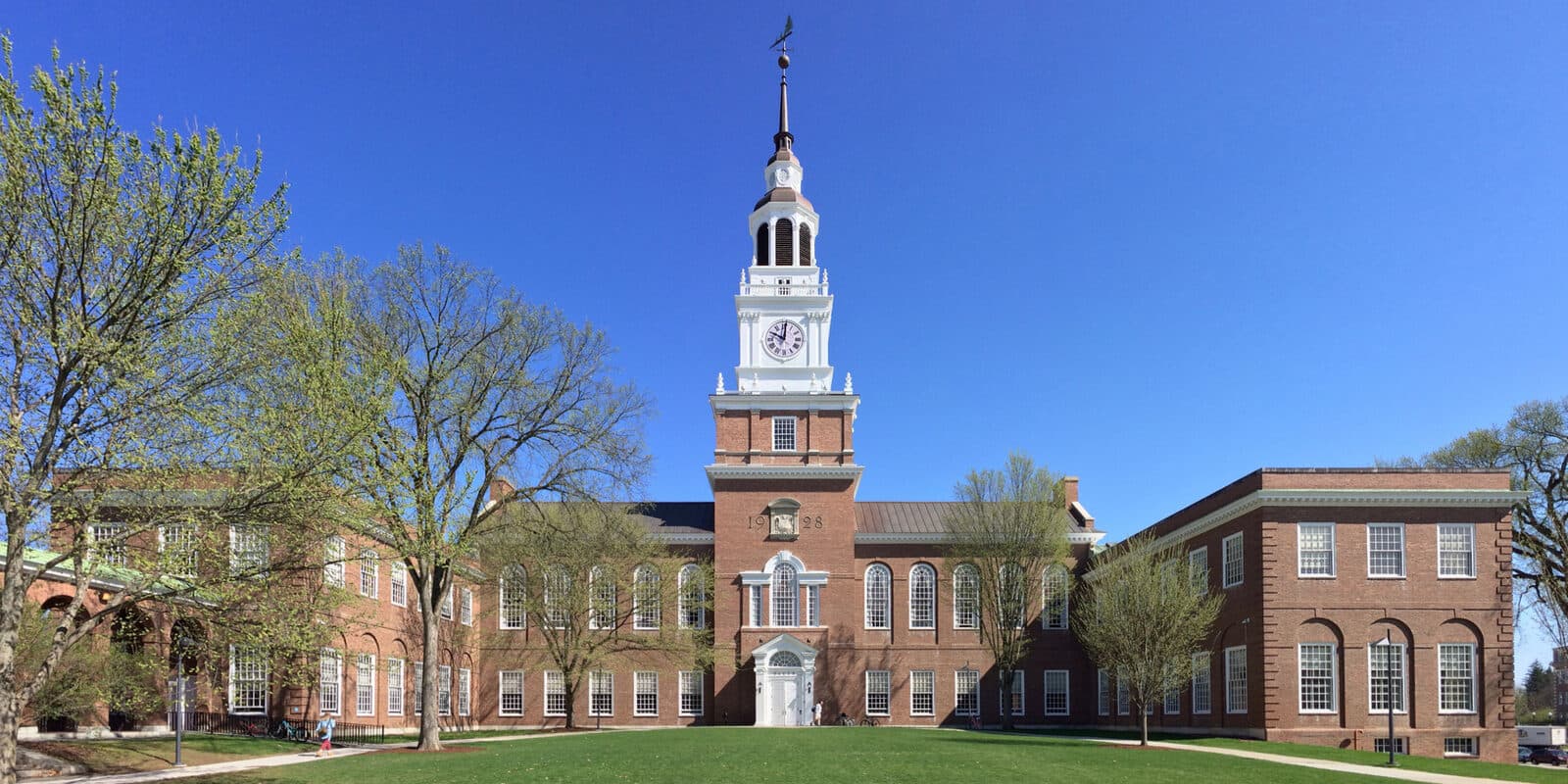

Dartmouth College
Dartmouth College is an Ivy League research university in Hanover, New Hampshire, and the smallest of the Ivies — known for its intense focus on undergraduate teaching, its rural campus on the edge of the White Mountains, and the year-round 'D-Plan' quarter calendar that sends students off-term to study, intern, or travel. Admission is extraordinarily selective: Dartmouth admitted about 6% of roughly 28,200 applicants, and enrolled first-years posted a middle-50% SAT of 1440–1550. The college has reinstated its SAT/ACT requirement, and the social sciences are its single most popular field, accounting for nearly a third of degrees. Dartmouth is need-blind for domestic applicants and meets 100% of demonstrated financial need.
See how Dartmouth compares
Pick up to two rivals — or search any school.
Dartmouth admissions statistics
Acceptance rate
Total applicants, admitted students, and enrolled students for the most recent admission cycle.
Early decision
Dartmouth offers binding Early Decision. Applying early can meaningfully change your odds — but ED commits you to enroll if admitted.
Admit rate by application plan
% admitted~5.7× higher admit rate applying early.
Standardized tests
Dartmouth requires standardized test scores for all applicants.
SAT Accepted?
ACT Accepted?
Test Optional?
SAT Scores
ACT Scores
Dartmouth application deadlines — Fall 2027
Last checked August 19, 2026. If you are applying, you should verify deadlines on Dartmouth’s site.
- Early DecisionNovember 1, 2026
- Regular DecisionJanuary 1, 2027
Source: Dartmouth’s admissions dates page · checked August 19, 2026
Dartmouth supplemental essays — 2026-2027 cycle
As you seek admission to Dartmouth's Class of 2031, what aspects of the college's academic program, community, and/or campus environment attract your interest? How is Dartmouth a good fit for you?
There is a Quaker saying: Let your life speak. Describe the environment in which you were raised and the impact it has had on the person you are today.
"Be yourself," Oscar Wilde advised. "Everyone else is taken." Introduce yourself.
What excites you?
Labor leader and civil rights activist Dolores Huerta recommended a life of purpose. "We must use our lives to make the world a better place to live, not just to acquire things," she said. "That is what we are put on the earth for." In what ways do you hope to make—or are you already making—an impact? Why? How?
In an Instagram post, best-selling British author Matt Haig cheered the impact of reading. "A good novel is the best invention humans have ever created for imagining other lives," he wrote. How have you experienced such insight from reading? What did you read and how did it alter the way you understand yourself and others?
The social and family interactions of wild chimpanzees have been the focus of Dame Jane Goodall's research for decades. Her understanding of animal behavior prompted the English primatologist to see a lesson for human communities as well: "Change happens by listening and then starting a dialogue with the people who are doing something you don't believe is right." Channel Dame Goodall: Tell us about a moment when you engaged in a difficult conversation or encountered someone with an opinion or perspective that was different from your own. How did you find common ground?
Celebrate your nerdy side.
"It's not easy being green…" was the frequent refrain of Kermit the Frog. How has difference been a part of your life, and how have you embraced it as part of your identity, outlook or sense of purpose?
Writing your Dartmouth application essay?
Paste your draft and get specific, line-by-line feedback on what is and isn't landing — scored against the rubrics admissions readers use.
Class rank
Where Dartmouth's enrolled first-years placed in their high school graduating class.
Based on the 44% of enrolled students who reported a class rank. Dartmouth does not publish an average GPA.
Admissions factors
How Dartmouth weighs each part of your application.
Rigor of High School Record
Academic GPA
Standardized Test Scores
Application Essay
Recommendations
Extracurricular Activities
Character / Personal Qualities
Talent / Ability
First Generation
Level of Applicant's Interest
Class Rank
Volunteer Work
Work Experience
Geographical Residence
State Residency
Alumni Relation
Racial / Ethnic Status
Religious Affiliation
Cost of attendance
Estimated full-time annual cost from Dartmouth's Common Data Set.
Private universities charge the same tuition regardless of state residency.
What families actually pay
Average net price — what was left to pay after grant aid — for students receiving federal financial aid.
Source: College Scorecard (2026)
Financial aid
Need-based aid statistics for full-time first-year students.
Frequently asked questions about Dartmouth admissions
Yes, Dartmouth is extraordinarily selective. In the most recent cycle it admitted about 6.0% of applicants, taking roughly 1,699 students from a pool of around 28,230 and enrolling about 1,205 first-years. That places it among the most competitive colleges in the country, with admitted students earning top grades in the most demanding courses available to them.
Dartmouth offers a binding Early Decision plan and no Early Action option. In the early round it received about 3,552 ED applications and admitted roughly 768 of them, an admit rate well above the roughly 6.0% overall acceptance rate. Because ED is binding, you can apply early to only one school and must enroll if accepted.
A 1500 is competitive at Dartmouth, sitting right at the median for enrolled students. The middle 50% of enrolled first-years scored between 1440 and 1550 on the SAT and 32 to 35 on the ACT, with a median SAT of 1520. Dartmouth has reinstated its testing requirement, so first-year applicants must submit SAT or ACT scores.
Yes. Dartmouth has reinstated its standardized testing requirement, so first-year applicants must submit SAT or ACT scores to be considered. Test scores are rated a very important factor in its holistic review, alongside the rigor of your coursework, GPA, essays, and recommendations.
Dartmouth does not collect or report an average high school GPA. Among the roughly 44% of enrolled first-years who submitted a class rank, about 96% ranked in the top tenth of their graduating class and 99% in the top quarter. In practice, admitted students earn near-perfect grades in the hardest courses their school offers.
Annual tuition and required fees run about $71,525, with on-campus food and housing adding roughly $20,900 more. Dartmouth is need-blind for domestic applicants and meets 100% of demonstrated financial need: about 49% of first-years receive need-based grant aid, with an average aid package near $73,208.
The social sciences are by far the most popular area at Dartmouth, accounting for about 30% of degrees conferred. They are followed by computer science (about 10%), interdisciplinary studies (about 9%), engineering (about 8%), and the biological sciences (about 7%), with engineering housed at the undergraduate Thayer School.
Yes, a great deal. Dartmouth rates the application essay as a very important factor in its admissions review, on the same tier as your GPA, course rigor, test scores, and recommendations. With an admit rate around 6.0%, a specific, well-revised essay is one of the clearest ways a strong applicant can stand out.
Esslo gives free line-by-line feedback on your draft. Try it now
Popular majors
Bachelor's degrees awarded in the past year by academic major.
Student-faculty ratio
The number of students for every one faculty member, indicating the average level of access students have to instructional staff.
Student outcomes
Median yearly income of former students who received federal aid, across every major, measured four years after graduating (2017–18 and 2018–19 graduates, earnings measured 2022–2023). Debt covers federal loans of students who completed.
Source: College Scorecard (2026)
Programs
Dartmouth’s most popular programs and median pay after graduation. Income data from the US Department of Education’s College Scorecard.
- Economics
163 degrees (2023-24)
~$153kmedian pay, 4 yrs after graduation~$18k median debt - Political Science
122 degrees (2023-24)
~$106kmedian pay, 4 yrs after graduation~$18k median debt - Computer Science
103 degrees (2023-24)
~$202kmedian pay, 4 yrs after graduation~$18k median debt - General EngineeringABET accreditedEngineering is accredited by ABET, the accreditor for engineering, computing, and applied science programs.
101 degrees (2023-24)
Not publishedmedian pay after graduation - Mathematics
44 degrees (2023-24)
~$169kmedian pay, 4 yrs after graduation~$12k median debt
Show all 21 programsShow fewer
- Biology
41 degrees (2023-24)
~$87kmedian pay, 4 yrs after graduation~$17k median debt - History
32 degrees (2023-24)
~$136kmedian pay, 4 yrs after graduation~$19k median debt - English
29 degrees (2023-24)
~$58kmedian pay, 4 yrs after graduation~$17k median debt - Neuroscience
29 degrees (2023-24)
~$143kmedian pay, 4 yrs after graduation~$18k median debt - Earth & Geological Sciences
25 degrees (2023-24)
Not publishedmedian pay after graduation - Philosophy
23 degrees (2023-24)
Not publishedmedian pay after graduation - Area Studies
21 degrees (2023-24)
~$65kmedian pay, 4 yrs after graduation~$17k median debt - Data Science
17 degrees (2023-24)
Not publishedmedian pay after graduation - Linguistics & Language Studies
16 degrees (2023-24)
Not publishedmedian pay after graduation - Chemistry
16 degrees (2023-24)
Not publishedmedian pay after graduation - Music
15 degrees (2023-24)
Not publishedmedian pay after graduation - Biomedical EngineeringNot ABET-accredited
14 degrees (2023-24)
Not publishedmedian pay after graduation - Fine & Studio Arts
13 degrees (2023-24)
~$69kmedian pay, 4 yrs after graduation~$14k median debt - Physics
8 degrees (2023-24)
Not publishedmedian pay after graduation - Environmental Science & Natural Resources
Degrees conferred not published (2023-24)
~$67kmedian pay, 4 yrs after graduation~$15k median debt - Psychology
Degrees conferred not published (2023-24)
~$87kmedian pay, 4 yrs after graduation
Median pay data is measured from graduates who received federal student aid.
Source: College Scorecard (2026) · IPEDS (2023-24) · ABET
Campus life
On-campus housing and Greek life participation rates.
Place
How the federal government classifies the area around the campus, and what a normal year of weather looks like there.
Average temperature
Monthly high and low, °FThirty-year averages, measured at the nearest weather station rather than on campus — they describe the area, not the campus.
Source: IPEDS (HD2024) · NOAA 1991–2020 U.S. Climate Normals, HANOVER, NH US station, 0.2 mi from campus
Enrollment by gender
Student diversity
Racial and ethnic breakdown of enrolled undergraduate students.
Source: Dartmouth College Common Data Set 2025-2026. Figures transcribed 2026-06-07. Esslo aggregates publicly reported data and is not affiliated with Dartmouth. Banner photo by Gunnar Klack, via Wikimedia Commons (CC BY-SA 4.0). Cite this page as: Esslo College Explorer, “Dartmouth College admissions statistics, transcribed from the 2025-2026 Common Data Set,” https://www.esslo.org/colleges/dartmouth (retrieved 2026-06-07).