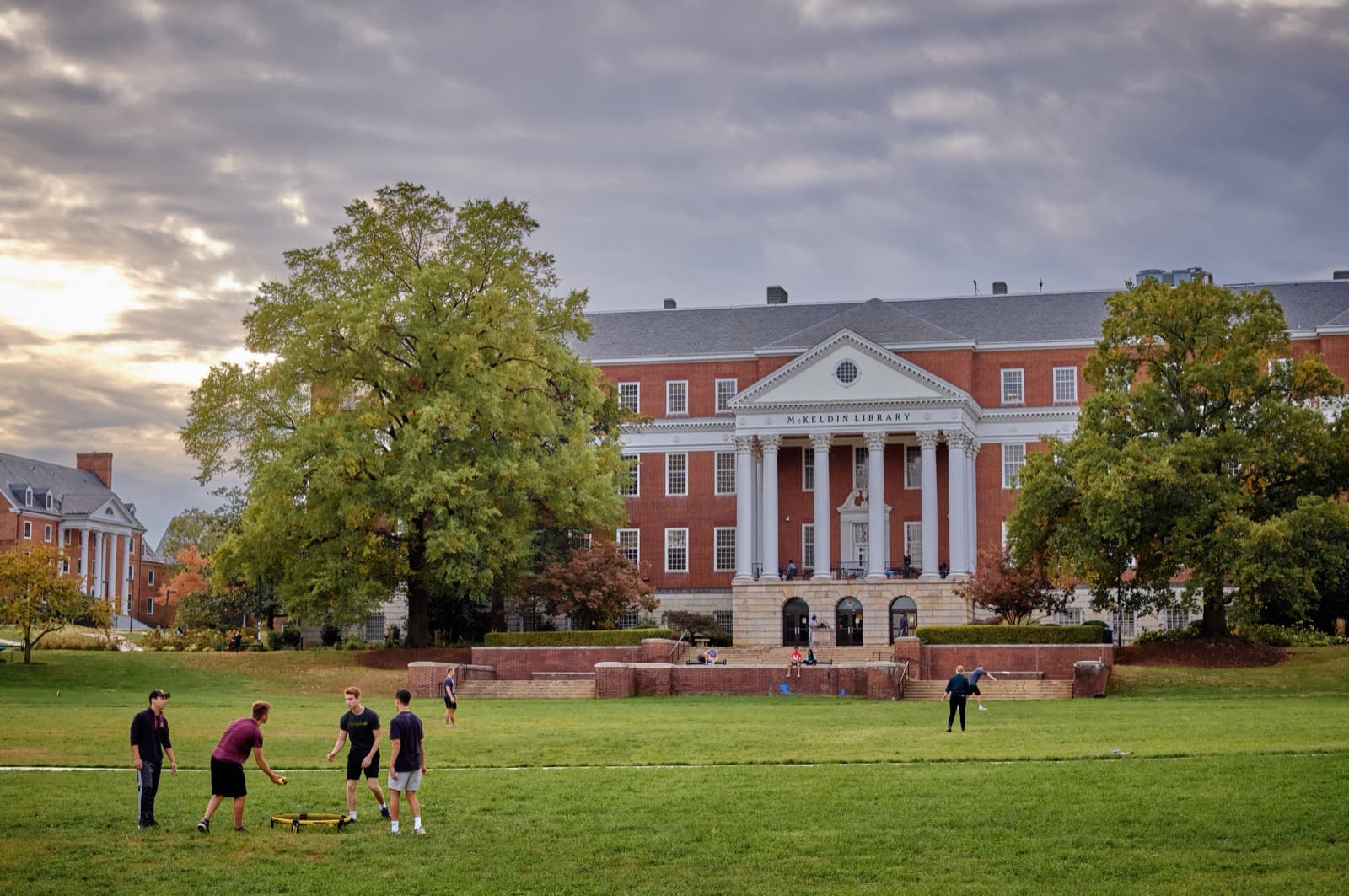

University of Maryland, College Park
The University of Maryland, College Park is the flagship public research university of the University System of Maryland, set just outside Washington, D.C., and enrolling nearly 31,900 undergraduates. Admission has grown highly selective — about 45% of roughly 67,000 applicants are admitted, and enrolled first-years carry an average high school GPA around 4.41 with middle-50% SAT scores of 1410–1520. Computer and information sciences is now the single largest field at about a quarter of bachelor's degrees, reflecting the school's strength in computing, engineering, and the sciences, and Maryland's low in-state tuition keeps it among the strongest values of any top public university.
See how Maryland compares
Pick up to two rivals — or search any school.
Maryland admissions statistics
Acceptance rate
Overall acceptance rate, plus the in-state and out-of-state admit rates the school reports separately.
Admit rate by residency
% admitted~1.1× higher admit rate for out-of-state applicants.
Early action
Maryland offers non-binding Early Action — an earlier decision with no commitment to enroll.
Standardized tests
Maryland is currently test-optional — you may apply without submitting scores.
SAT Accepted?
ACT Accepted?
Test Optional?
SAT Scores
ACT Scores
Maryland application deadlines — Fall 2027
Last checked August 19, 2026. If you are applying, you should verify deadlines on Maryland’s site.
- Early ActionNovember 1, 2026
For priority consideration, applicants are strongly encouraged to apply by the early action deadline
- Regular DecisionJanuary 20, 2027
Applications received after the regular deadline will be considered on a rolling, space-available basis
Source: Maryland’s admissions dates page · checked August 19, 2026
Maryland supplemental essays — 2026-2027 cycle
If I could travel anywhere, I would go to...
The most interesting fact I ever learned from research was...
In addition to my major, my academic interests include...
My favorite thing about last Tuesday was...
Something you might not know about me is...
Because we know that diversity benefits the educational experience of all students, the University of Maryland values diversity in all of its many forms. This includes (but is not limited to) racial, socio-economic, gender, geographical, and sexual orientation. We are interested in hearing about your own individual life experiences. In a few sentences, will you please describe how you have learned, grown, been inspired or developed skills through one or more components of diversity. (Maximum 650 characters)
Writing your Maryland application essay?
Paste your draft and get specific, line-by-line feedback on what is and isn't landing — scored against the rubrics admissions readers use.
Class rank
Where Maryland's enrolled first-years placed in their high school graduating class.
Based on the 24.8% of enrolled students who reported a class rank. Maryland does not publish an average GPA.
Admissions factors
How Maryland weighs each part of your application.
Rigor of High School Record
Academic GPA
Standardized Test Scores
Application Essay
Recommendations
Extracurricular Activities
Character / Personal Qualities
Talent / Ability
First Generation
Level of Applicant's Interest
Class Rank
Volunteer Work
Work Experience
Geographical Residence
State Residency
Alumni Relation
Racial / Ethnic Status
Religious Affiliation
Cost of attendance
Estimated full-time annual cost from Maryland's Common Data Set. Only tuition changes with residency.
What families actually pay
Average net price — what was left to pay after grant aid — for students receiving federal financial aid, covering in-state students only.
Source: College Scorecard (2026)
Financial aid
Need-based aid statistics for full-time first-year students.
Frequently asked questions about Maryland admissions
Admitted first-years at Maryland report an average high school GPA of about 4.41 on a weighted scale, and among the roughly 25% of enrolled students who reported a class rank, about 76% were in the top tenth of their class. There is no hard cutoff, but the rigor of your high school course load is rated the single 'very important' academic factor in UMD's review.
Maryland is competitive but not a long shot: it admitted about 45% of applicants in the most recent cycle, drawing roughly 67,000 applications and enrolling around 6,560 first-years. The bigger hurdle is the major — admission to limited-enrollment programs like computer science and engineering is far more selective than the 45% campus-wide rate suggests.
Maryland's overall acceptance rate is about 45%, from roughly 67,000 applications with around 6,560 first-years enrolling. Because admission is by intended major, competitive programs such as computer science — now about 25% of all bachelor's degrees — run meaningfully tighter than the headline rate.
Counterintuitively, out-of-state applicants are admitted at a slightly higher rate than Maryland residents. According to USM IRIS data for Fall 2025, the in-state admit rate is about 41% while the out-of-state admit rate is about 47%. The overall 45% campus-wide figure blends both groups. State residency and geographical residence are each listed as 'considered' factors in UMD's holistic review, but the numbers show that being from out of state is not a disadvantage in the admissions process.
Yes — a 1490 sits squarely in Maryland's competitive range. The middle 50% of enrolled first-years scored 1410 to 1520 on the SAT (32 to 35 on the ACT), so a 1490 lands near the upper half. UMD is test-optional, so scores are weighed alongside grades, rigor, and the rest of your application rather than as a cutoff.
Yes, Maryland is test-optional — you can apply without SAT or ACT scores, and submitted scores are considered alongside every other factor rather than required. For students who do submit, the middle 50% of enrolled first-years scored 1410 to 1520 on the SAT and 32 to 35 on the ACT.
Annual tuition and required fees run about $12,290 for Maryland residents and $42,053 for out-of-state students. Roughly 28% of first-years receive need-based grant aid, with an average package near $19,426, and UMD meets about 74% of demonstrated financial need on average.
Computer and information sciences is by far the largest field at about 25% of bachelor's degrees, followed by business and marketing, the social sciences, and engineering. Maryland also confers strong shares in the biological and life sciences, health professions, psychology, and journalism.
Popular majors
Bachelor's degrees awarded in the past year by academic major.
Student-faculty ratio
The number of students for every one faculty member, indicating the average level of access students have to instructional staff.
Student outcomes
Median yearly income of former students who received federal aid, across every major, measured four years after graduating (2017–18 and 2018–19 graduates, earnings measured 2022–2023). Debt covers federal loans of students who completed.
Source: College Scorecard (2026)
Programs
Maryland’s most popular programs and median pay after graduation. Income data from the US Department of Education’s College Scorecard.
- Computer Science
948 degrees (2023-24)
~$138kmedian pay, 4 yrs after graduation~$20k median debt - Biology
428 degrees (2023-24)
~$65kmedian pay, 4 yrs after graduation~$18k median debt - Psychology
395 degrees (2023-24)
~$58kmedian pay, 4 yrs after graduation~$20k median debt - Public Health
389 degrees (2023-24)
~$72kmedian pay, 4 yrs after graduation~$22k median debt - Finance
359 degrees (2023-24)
~$111kmedian pay, 4 yrs after graduation~$20k median debt
Show all 37 programsShow fewer
- Mechanical EngineeringABET accreditedMechanical Engineering is accredited by ABET, the accreditor for engineering, computing, and applied science programs.
302 degrees (2023-24)
~$100kmedian pay, 4 yrs after graduation~$20k median debt - Political Science
254 degrees (2023-24)
~$74kmedian pay, 4 yrs after graduation~$18k median debt - Communication & Media Studies
253 degrees (2023-24)
~$74kmedian pay, 4 yrs after graduation~$17k median debt - Economics
250 degrees (2023-24)
~$84kmedian pay, 4 yrs after graduation~$19k median debt - Business Administration & Management
196 degrees (2023-24)
~$87kmedian pay, 4 yrs after graduation~$20k median debt - Mathematics
185 degrees (2023-24)
~$100kmedian pay, 4 yrs after graduation~$20k median debt - Kinesiology & Exercise Science
179 degrees (2023-24)
~$62kmedian pay, 4 yrs after graduation~$21k median debt - Architecture
138 degrees (2023-24)
~$69kmedian pay, 4 yrs after graduation~$21k median debt - Aerospace EngineeringABET accreditedAerospace Engineering is accredited by ABET, the accreditor for engineering, computing, and applied science programs.
130 degrees (2023-24)
~$98kmedian pay, 4 yrs after graduation~$21k median debt - Civil EngineeringABET accreditedCivil Engineering is accredited by ABET, the accreditor for engineering, computing, and applied science programs.
118 degrees (2023-24)
~$93kmedian pay, 4 yrs after graduation~$20k median debt - Journalism
108 degrees (2023-24)
~$68kmedian pay, 4 yrs after graduation~$22k median debt - Neuroscience
107 degrees (2023-24)
Not publishedmedian pay after graduation - English
103 degrees (2023-24)
~$59kmedian pay, 4 yrs after graduation~$20k median debt - Electrical EngineeringABET accreditedElectrical Engineering is accredited by ABET, the accreditor for engineering, computing, and applied science programs.
99 degrees (2023-24)
~$108kmedian pay, 4 yrs after graduation~$21k median debt - Computer EngineeringABET accreditedComputer Engineering is accredited by ABET, the accreditor for engineering, computing, and applied science programs.
98 degrees (2023-24)
~$152kmedian pay, 4 yrs after graduation~$20k median debt - Public Policy
93 degrees (2023-24)
~$46kmedian pay, 1 yr after graduation~$20k median debt - Fine & Studio Arts
83 degrees (2023-24)
~$56kmedian pay, 4 yrs after graduation~$19k median debt - Philosophy
68 degrees (2023-24)
~$65kmedian pay, 4 yrs after graduation~$20k median debt - Physics
63 degrees (2023-24)
~$91kmedian pay, 4 yrs after graduation~$20k median debt - History
59 degrees (2023-24)
~$60kmedian pay, 4 yrs after graduation~$21k median debt - Human Development & Family Studies
55 degrees (2023-24)
~$65kmedian pay, 4 yrs after graduation~$19k median debt - Environmental Science & Natural Resources
45 degrees (2023-24)
~$59kmedian pay, 4 yrs after graduation~$20k median debt - Biochemistry & Molecular Biology
42 degrees (2023-24)
~$80kmedian pay, 4 yrs after graduation~$20k median debt - Chemistry
41 degrees (2023-24)
~$80kmedian pay, 4 yrs after graduation~$17k median debt - Chemical EngineeringABET accreditedChemical Engineering is accredited by ABET, the accreditor for engineering, computing, and applied science programs.
39 degrees (2023-24)
~$102kmedian pay, 4 yrs after graduation~$22k median debt - Music
36 degrees (2023-24)
~$48kmedian pay, 4 yrs after graduation~$22k median debt - Agricultural Business
25 degrees (2023-24)
~$79kmedian pay, 4 yrs after graduation~$15k median debt - Linguistics & Language Studies
14 degrees (2023-24)
Not publishedmedian pay after graduation - Earth & Geological Sciences
8 degrees (2023-24)
Not publishedmedian pay after graduation - Area Studies
5 degrees (2023-24)
~$59kmedian pay, 4 yrs after graduation~$18k median debt - Computer & Information Sciences
Degrees conferred not published (2023-24)
~$145kmedian pay, 4 yrs after graduation - Biomedical EngineeringABET accreditedBioengineering is accredited by ABET, the accreditor for engineering, computing, and applied science programs.
Degrees conferred not published (2023-24)
Not publishedmedian pay after graduation
Median pay data is measured from graduates who received federal student aid.
Source: College Scorecard (2026) · IPEDS (2023-24) · ABET
Campus life
On-campus housing and Greek life participation rates.
Place
How the federal government classifies the area around the campus, and what a normal year of weather looks like there.
Average temperature
Monthly high and low, °FThirty-year averages, measured at the nearest weather station rather than on campus — they describe the area, not the campus.
Source: IPEDS (HD2024) · NOAA 1991–2020 U.S. Climate Normals, BELTSVILLE, MD US station, 3.0 mi from campus
Enrollment by gender
Student diversity
Racial and ethnic breakdown of enrolled undergraduate students.
Source: University of Maryland, College Park Common Data Set 2025-2026. Figures transcribed 2026-06-07. Esslo aggregates publicly reported data and is not affiliated with Maryland. Banner photo by Blacktupelo, via Wikimedia Commons (CC BY-SA 4.0). Cite this page as: Esslo College Explorer, “University of Maryland, College Park admissions statistics, transcribed from the 2025-2026 Common Data Set,” https://www.esslo.org/colleges/maryland (retrieved 2026-06-07).