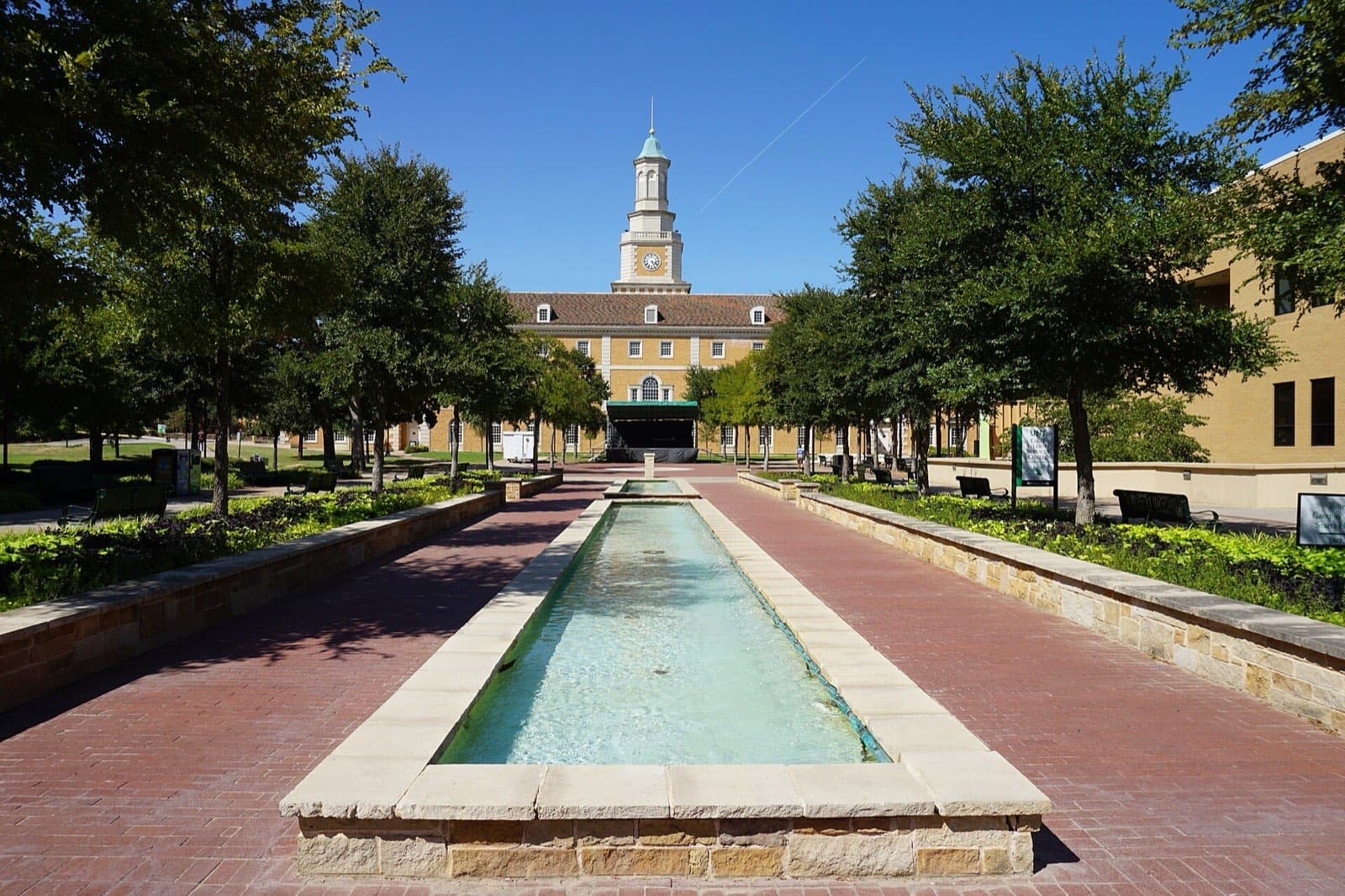

University of North Texas
The University of North Texas is a public R1 research university in Denton, about 40 miles north of Dallas and Fort Worth, and one of the five largest universities in Texas with roughly 34,400 undergraduates. Admission is accessible: UNT admits about 71% of applicants and guarantees a spot to Texas students who earn a 3.25 GPA or rank in the top 30% of their class. Its College of Music is among the most renowned in the country, home to the Grammy-winning One O'Clock Lab Band, and Business is the most popular undergraduate field. UNT stays test-optional, and among first-years who submit scores the middle 50% land at 960–1210 on the SAT and 19–26 on the ACT.
See how North Texas compares
Pick up to two rivals — or search any school.
North Texas admissions statistics
Acceptance rate
Overall acceptance rate, plus the in-state and out-of-state admit rates the school reports separately.
Admit rate by residency
% admittedEarly admissions
North Texas does not offer an Early Decision or Early Action plan; all applicants apply through Regular Decision.
Standardized tests
North Texas is currently test-optional — you may apply without submitting scores.
SAT Accepted?
ACT Accepted?
Test Optional?
SAT Scores
ACT Scores
North Texas supplemental essays
North Texas requires no supplemental essay for the 2026-2027 cycle — your Common App personal statement is the only essay they read.
Writing your North Texas application essay?
Paste your draft and get specific, line-by-line feedback on what is and isn't landing — scored against the rubrics admissions readers use.
Class rank
Where North Texas's enrolled first-years placed in their high school graduating class.
Based on the 93% of enrolled students who reported a class rank. North Texas does not publish an average GPA.
Admissions factors
How North Texas weighs each part of your application.
Rigor of High School Record
Academic GPA
Standardized Test Scores
Application Essay
Recommendations
Extracurricular Activities
Character / Personal Qualities
Talent / Ability
First Generation
Level of Applicant's Interest
Class Rank
Volunteer Work
Work Experience
Geographical Residence
State Residency
Alumni Relation
Racial / Ethnic Status
Religious Affiliation
Cost of attendance
Estimated full-time annual cost from North Texas's Common Data Set. Only tuition changes with residency.
Financial aid
Need-based aid statistics for full-time first-year students.
Frequently asked questions about North Texas admissions
No, UNT is not hard to get into. It admitted about 71% of applicants in the most recent cycle, drawing roughly 41,000 applications and enrolling around 6,400 first-year students. Texas residents who earn a 3.25 unweighted GPA or rank in the top 30% of their graduating class qualify for guaranteed admission.
A 3.25 unweighted high school GPA guarantees admission for Texas students, and ranking in the top 30% of your class does the same. UNT does not publish an average admitted GPA, but among enrolled first-years who reported a class rank, about 39% were in the top quarter and 77% in the top half. Academic GPA and the rigor of your coursework are weighed as very important factors.
Yes, a 1200 is strong for UNT. It sits near the 75th-percentile mark of 1210, putting you above most enrolled first-years. The middle 50% who submitted scores landed at 960–1210 on the SAT and 19–26 on the ACT, and a 1100 SAT or 22 ACT already meets UNT's test threshold for guaranteed admission.
Yes, UNT is test-optional, so you can apply without SAT or ACT scores. Submitting scores can still help with admission review, course placement, and scholarships. Among first-years who did submit, the middle 50% scored 960–1210 on the SAT and 19–26 on the ACT.
Out-of-state applicants are admitted at essentially the same rate as Texas residents. For Fall 2024, UNT admitted about 73% of in-state applicants and 73% of out-of-state applicants, while international applicants were admitted at roughly 58%. Out-of-state students are also exempt from the Texas Uniform Admission Policy, and state residency is listed as a factor that is not considered in admission decisions.
Annual tuition and required fees run about $11,663 for Texas residents and $23,813 for out-of-state students. Roughly 59% of first-years receive need-based grant aid, the average need-based aid package runs about $16,410, and UNT meets around 63% of demonstrated need on average.
No, UNT does not require an essay or recommendations for most applicants, and it rates both as not considered in its standard freshman review. The university leans on GPA, class rank, and course rigor instead. Applicants reviewed holistically because they fall short of guaranteed admission may be asked to submit an essay and other documents.
Business is the largest undergraduate field at UNT, followed by multidisciplinary studies and the visual and performing arts, with the College of Music ranking among the strongest in the nation. Computing, psychology, communication, and the biological sciences round out the most popular areas across UNT's 100-plus bachelor's programs.
Popular majors
Bachelor's degrees awarded in the past year by academic major.
Student-faculty ratio
The number of students for every one faculty member, indicating the average level of access students have to instructional staff.
Campus life
On-campus housing and Greek life participation rates.
Enrollment by gender
Student diversity
Racial and ethnic breakdown of enrolled undergraduate students.
Source: University of North Texas Common Data Set 2025-2026. Figures transcribed 2026-06-25. Esslo aggregates publicly reported data and is not affiliated with North Texas. Banner photo by Michael Barera, via Wikimedia Commons (CC BY-SA 4.0). Cite this page as: Esslo College Explorer, “University of North Texas admissions statistics, transcribed from the 2025-2026 Common Data Set,” https://www.esslo.org/colleges/north-texas (retrieved 2026-06-25).