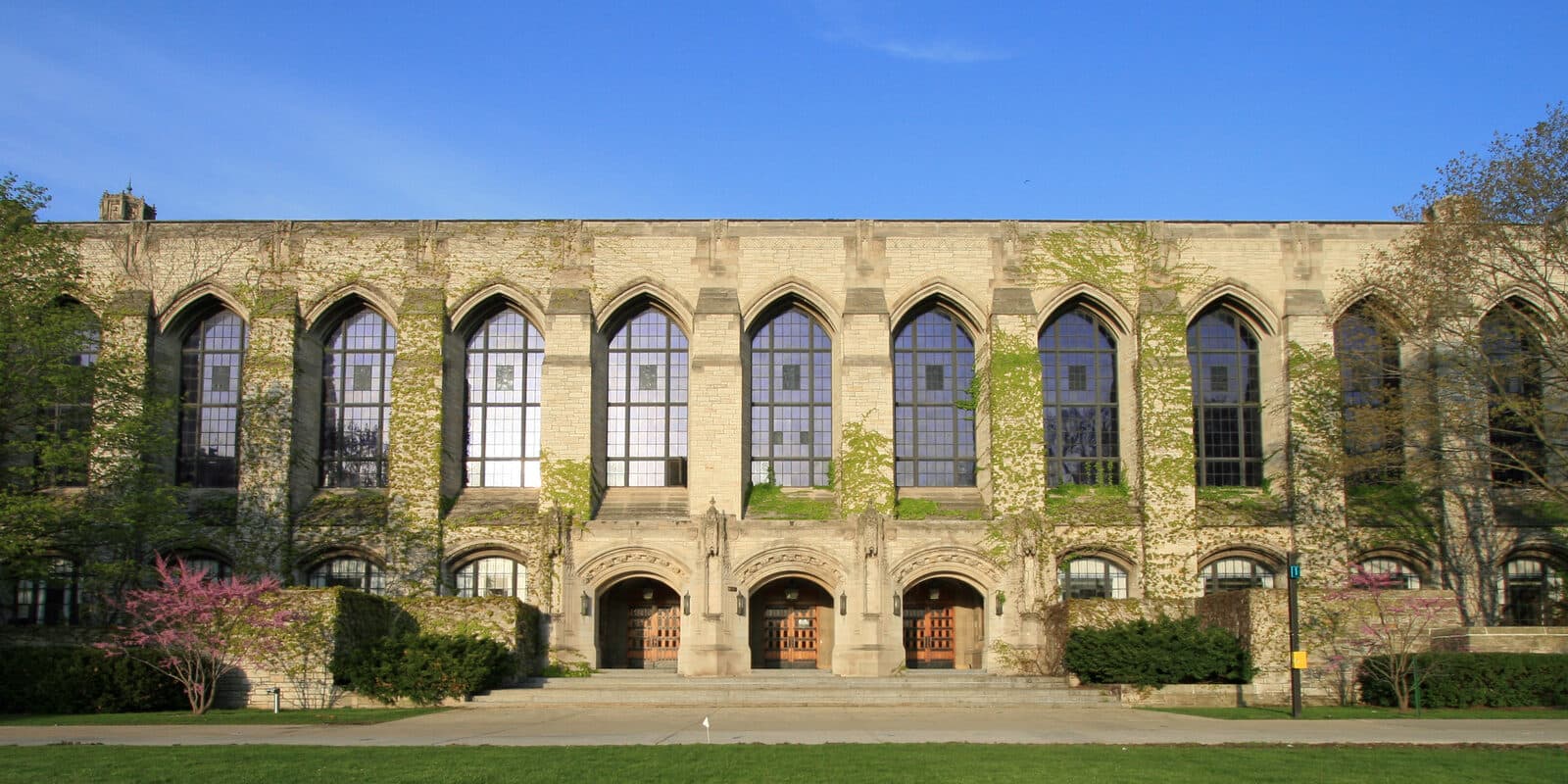

Northwestern University
Northwestern University is a private research university on the shore of Lake Michigan in Evanston, Illinois, just north of Chicago, known for its top-ranked Medill School of Journalism, strong engineering and economics programs, and a distinctive quarter-system calendar. Admission is extremely competitive — Northwestern admitted about 7.7% of roughly 49,000 first-year applicants, and enrolled students who submitted scores posted middle-50% SATs of 1510–1560 and ACTs of 34–35. The university is test-optional, retains 98% of first-years into their second year, and meets 100% of demonstrated financial need. The figures below are drawn directly from Northwestern's official Common Data Set.
See how Northwestern compares
Pick up to two rivals — or search any school.
Northwestern admissions statistics
Acceptance rate
Total applicants, admitted students, and enrolled students for the most recent admission cycle.
Early decision
Northwestern offers binding Early Decision. Applying early can meaningfully change your odds — but ED commits you to enroll if admitted.
Admit rate by application plan
% admitted~3.9× higher admit rate applying early.
Standardized tests
Northwestern is currently test-optional — you may apply without submitting scores.
SAT Accepted?
ACT Accepted?
Test Optional?
SAT Scores
ACT Scores
Northwestern application deadlines — Fall 2027
Last checked August 19, 2026. If you are applying, you should verify deadlines on Northwestern’s site.
- Early DecisionNovember 1, 2026
- Regular DecisionJanuary 4, 2027
Source: Northwestern’s admissions dates page · checked August 19, 2026
Northwestern supplemental essays — 2026-2027 cycle
We want to be sure we're considering your application in the context of your personal experiences: What aspects of your background (your identity, your school setting, your community, your household, etc.) have most shaped how you see yourself engaging in Northwestern's community, be it academically, extracurricularly, culturally, politically, socially, or otherwise?
Painting "The Rock" is a tradition at Northwestern that invites all forms of expression—students promote campus events or extracurricular groups, support social or activist causes, show their Wildcat spirit (what we call "Purple Pride"), celebrate their culture, and more. What would you paint on The Rock, and why?
Northwestern fosters a distinctively interdisciplinary culture. We believe discovery and innovation thrive at the intersection of diverse ideas, perspectives, and academic interests. Within this setting, if you could dream up an undergraduate class, research project, or creative effort (a start-up, a design prototype, a performance, etc.), what would it be? Who might be some ideal classmates or collaborators?
Community and belonging matter at Northwestern. Tell us about one or more communities, networks, or student groups you see yourself connecting with on campus.
Northwestern's location is special: on the shore of Lake Michigan, steps from downtown Evanston, just a few miles from Chicago. What aspects of our location are most compelling to you, and why?
Northwestern is a place where people with diverse backgrounds from all over the world can study, live, and talk with one another. This range of experiences and viewpoints immeasurably enriches learning. How might your individual background contribute to this diversity of perspectives in Northwestern's classrooms and around our campus?
Writing your Northwestern application essay?
Paste your draft and get specific, line-by-line feedback on what is and isn't landing — scored against the rubrics admissions readers use.
Admissions factors
How Northwestern weighs each part of your application.
Rigor of High School Record
Academic GPA
Standardized Test Scores
Application Essay
Recommendations
Extracurricular Activities
Character / Personal Qualities
Talent / Ability
First Generation
Level of Applicant's Interest
Class Rank
Volunteer Work
Work Experience
Geographical Residence
State Residency
Alumni Relation
Racial / Ethnic Status
Religious Affiliation
Cost of attendance
Estimated full-time annual cost from Northwestern's Common Data Set.
Private universities charge the same tuition regardless of state residency.
What families actually pay
Average net price — what was left to pay after grant aid — for students receiving federal financial aid.
Source: College Scorecard (2026)
Financial aid
Need-based aid statistics for full-time first-year students.
Frequently asked questions about Northwestern admissions
Yes — Northwestern is extremely selective, admitting about 7.7% of applicants in the most recent cycle. It offered admission to roughly 3,806 of about 49,474 first-year applicants and enrolled around 2,105 students. Admission is holistic: the rigor of your course load, GPA, class rank, essays, recommendations, extracurriculars, and personal qualities are all weighed as very important factors.
Northwestern admitted about 7.7% of first-year applicants in the most recent cycle — roughly 3,806 offers out of about 49,474 applications, with around 2,105 students enrolling. Northwestern also offers a binding Early Decision plan, which received 5,154 applications and admitted 1,186 students for the entering class.
Northwestern does not publish a single average high school GPA on its Common Data Set, but admitted students are almost uniformly near the top of their classes. The review is holistic, and the rigor of your secondary school record, academic GPA, and class rank are each weighed as very important factors — so the strongest applications pair a near-perfect transcript with the most demanding course load your school offers.
No. Northwestern is test-optional, so you may apply without submitting scores, and standardized test scores are only 'considered' in the holistic review rather than weighed heavily. Among enrolled students who did submit, the middle 50% scored 1510–1560 on the SAT and 34–35 on the ACT.
A 1500 sits just below the middle-50% range for enrolled students who submitted scores, which runs 1510–1560 on the SAT (34–35 ACT). Because Northwestern is test-optional and treats scores as only 'considered,' a 1500 won't sink a strong application — but the admitted class skews very high, with 97% of score-submitters reporting a 1400–1600. A score below your target is one reason applicants choose to apply without scores.
Northwestern offers a binding Early Decision plan and no Early Action. In the most recent cycle the ED round received 5,154 applications and admitted 1,186 students for the entering class. ED is binding, so apply early only if Northwestern is clearly your first choice; the same very important factors — course rigor, GPA, essays, and extracurriculars — drive the decision.
Tuition and required fees run about $70,589 per year, with on-campus housing and food adding roughly $21,975 and books about $1,539 on top. Northwestern meets 100% of demonstrated financial need; about 44% of first-years receive need-based aid, and the average need-based package is roughly $67,785.
The social sciences are the single most popular area at about 18% of degrees, followed by engineering (12%) and communication and journalism (11%), the latter anchored by the Medill School. The biological and life sciences (10%), computer and information sciences (9%), psychology (7%), and the visual and performing arts (8%) round out the most-conferred fields.
Popular majors
Bachelor's degrees awarded in the past year by academic major.
Student-faculty ratio
The number of students for every one faculty member, indicating the average level of access students have to instructional staff.
Student outcomes
Median yearly income of former students who received federal aid, across every major, measured four years after graduating (2017–18 and 2018–19 graduates, earnings measured 2022–2023). Debt covers federal loans of students who completed.
Source: College Scorecard (2026)
Programs
Northwestern’s most popular programs and median pay after graduation. Income data from the US Department of Education’s College Scorecard.
- Economics
241 degrees (2023-24)
~$126kmedian pay, 4 yrs after graduation~$15k median debt - Biology
137 degrees (2023-24)
~$71kmedian pay, 4 yrs after graduation~$15k median debt - Computer Science
120 degrees (2023-24)
~$155kmedian pay, 4 yrs after graduation~$15k median debt - Neuroscience
110 degrees (2023-24)
~$54kmedian pay, 4 yrs after graduation~$17k median debt - Psychology
93 degrees (2023-24)
~$74kmedian pay, 4 yrs after graduation~$14k median debt
Show all 33 programsShow fewer
- Mechanical EngineeringABET accreditedMechanical Engineering is accredited by ABET, the accreditor for engineering, computing, and applied science programs.
78 degrees (2023-24)
~$98kmedian pay, 4 yrs after graduation~$14k median debt - Communication & Media Studies
77 degrees (2023-24)
~$94kmedian pay, 4 yrs after graduation~$18k median debt - Music
76 degrees (2023-24)
~$54kmedian pay, 4 yrs after graduation~$18k median debt - Political Science
68 degrees (2023-24)
~$73kmedian pay, 4 yrs after graduation~$17k median debt - Biomedical EngineeringABET accreditedBiomedical Engineering is accredited by ABET, the accreditor for engineering, computing, and applied science programs.
65 degrees (2023-24)
~$103kmedian pay, 4 yrs after graduation~$17k median debt - Industrial EngineeringNot ABET-accredited
65 degrees (2023-24)
~$139kmedian pay, 4 yrs after graduation~$18k median debt - Public Policy
40 degrees (2023-24)
~$79kmedian pay, 4 yrs after graduation~$19k median debt - Chemical EngineeringABET accreditedChemical Engineering is accredited by ABET, the accreditor for engineering, computing, and applied science programs.
28 degrees (2023-24)
~$111kmedian pay, 4 yrs after graduation~$17k median debt - Mathematics
25 degrees (2023-24)
~$107kmedian pay, 4 yrs after graduation~$12k median debt - History
24 degrees (2023-24)
~$79kmedian pay, 4 yrs after graduation~$16k median debt - English
22 degrees (2023-24)
~$62kmedian pay, 4 yrs after graduation~$15k median debt - Data Science
21 degrees (2023-24)
Not publishedmedian pay after graduation - Civil EngineeringABET accreditedCivil Engineering is accredited by ABET, the accreditor for engineering, computing, and applied science programs.
21 degrees (2023-24)
Not publishedmedian pay after graduation - Computer EngineeringABET accreditedComputer Engineering is accredited by ABET, the accreditor for engineering, computing, and applied science programs.
21 degrees (2023-24)
Not publishedmedian pay after graduation - Electrical EngineeringABET accreditedElectrical Engineering is accredited by ABET, the accreditor for engineering, computing, and applied science programs.
21 degrees (2023-24)
Not publishedmedian pay after graduation - Human Development & Family Studies
19 degrees (2023-24)
Not publishedmedian pay after graduation - Physics
17 degrees (2023-24)
Not publishedmedian pay after graduation - Environmental Science & Natural Resources
16 degrees (2023-24)
Not publishedmedian pay after graduation - Chemistry
14 degrees (2023-24)
Not publishedmedian pay after graduation - Philosophy
9 degrees (2023-24)
Not publishedmedian pay after graduation - Linguistics & Language Studies
8 degrees (2023-24)
Not publishedmedian pay after graduation - Fine & Studio Arts
7 degrees (2023-24)
Not publishedmedian pay after graduation - Area Studies
5 degrees (2023-24)
Not publishedmedian pay after graduation - General EngineeringNot ABET-accredited
3 degrees (2023-24)
Not publishedmedian pay after graduation - Earth & Geological Sciences
2 degrees (2023-24)
Not publishedmedian pay after graduation - Computer & Information Sciences
1 degrees (2023-24)
Not publishedmedian pay after graduation - Journalism
Degrees conferred not published (2023-24)
~$80kmedian pay, 4 yrs after graduation~$15k median debt - Public Health
Degrees conferred not published (2023-24)
~$40kmedian pay, 1 yr after graduation~$15k median debt
Median pay data is measured from graduates who received federal student aid.
Source: College Scorecard (2026) · IPEDS (2023-24) · ABET
Campus life
On-campus housing and Greek life participation rates.
Place
How the federal government classifies the area around the campus, and what a normal year of weather looks like there.
Average temperature
Monthly high and low, °FThirty-year averages, measured at the nearest weather station rather than on campus — they describe the area, not the campus.
Source: IPEDS (HD2024) · NOAA 1991–2020 U.S. Climate Normals, CHICAGO BOTANIC GARDEN, IL US station, 8.2 mi from campus
Enrollment by gender
Student diversity
Racial and ethnic breakdown of enrolled undergraduate students.
Source: Northwestern University Common Data Set 2024-2025. Figures transcribed 2026-06-07. Esslo aggregates publicly reported data and is not affiliated with Northwestern. Banner photo by Madcoverboy, via Wikimedia Commons (CC BY-SA 3.0). Cite this page as: Esslo College Explorer, “Northwestern University admissions statistics, transcribed from the 2024-2025 Common Data Set,” https://www.esslo.org/colleges/northwestern (retrieved 2026-06-07).