.png&w=96&q=75)
Pennsylvania State University
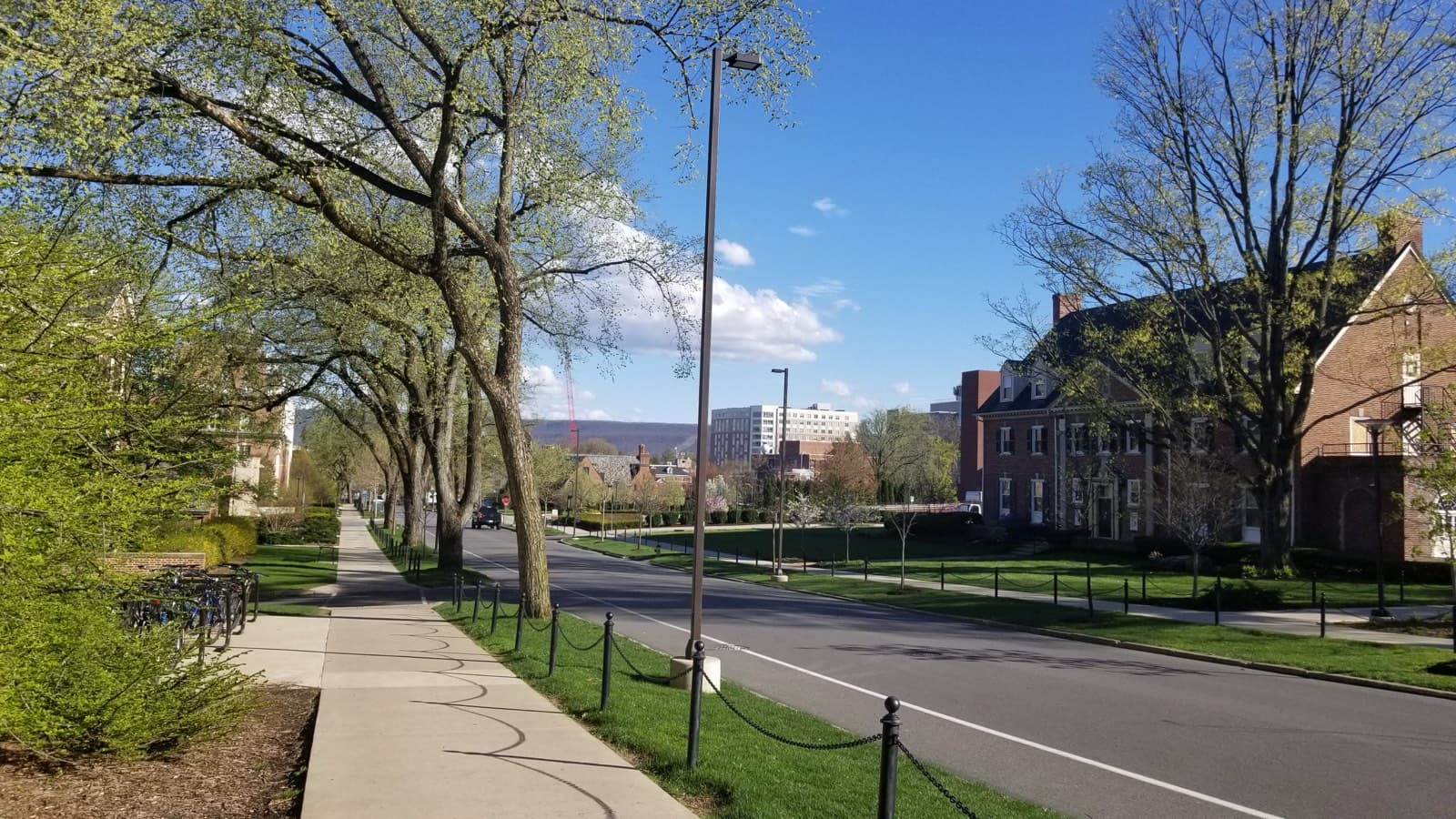
Pennsylvania State University's University Park campus is the flagship of Penn State's statewide system and one of the largest universities in the country, enrolling roughly 42,800 undergraduates in the heart of State College. Admission is moderately selective — about 55% of more than 106,000 applicants are offered a place — and enrolled first-years carry an average high school GPA near 3.67 with middle-50% SAT scores of 1280–1410. Business and marketing is the most popular field at about 17% of bachelor's degrees, followed by engineering and computer science, and Penn State's strong 92% first-year retention rate, expansive alumni network, and storied Nittany Lion athletics anchor one of the most recognizable public universities in the Northeast.
See how Penn State compares
Pick up to two rivals — or search any school.
Penn State admissions statistics
Acceptance rate
Overall acceptance rate, plus the in-state and out-of-state admit rates the school reports separately.
Admit rate by residency
% admittedEarly action
Penn State offers non-binding Early Action — an earlier decision with no commitment to enroll.
Standardized tests
Penn State is currently test-optional — you may apply without submitting scores.
SAT Accepted?
ACT Accepted?
Test Optional?
SAT Scores
ACT Scores
Penn State application deadlines — Fall 2027
Last checked August 19, 2026. If you are applying, you should verify deadlines on Penn State’s site.
- Early ActionNovember 1, 2026
in order to receive a decision by December 24
- Priority dateDecember 1, 2026
recommended submission deadline
Source: Penn State’s admissions dates page · checked August 19, 2026
Penn State supplemental essays — 2026-2027 cycle
Identify an important global or local issue that you believe does not receive sufficient attention. Why is this issue often overlooked or under-addressed? Analyze possible paths forward and propose a realistic strategy to raise awareness and advance solutions. Finally, evaluate your proposal's potential to create meaningful change, considering its feasibility, limitations, trade-offs, implementation challenges, and possible unintended consequences.
One of the Schreyer Honors College values is Empowered Growth. What values, beliefs or experiences have empowered you to grow intellectually and/or personally?
If you were able to go anywhere in the world, outside of the country you currently reside, where would you go and why?
Describe a significant leadership experience that has shaped who you are. This may include roles in your community, family, research, work, or extracurricular involvement. What challenges did you encounter, how did you respond, and what did you learn about leadership?
Reflecting on the recognitions listed above, which one stands out as having an impact on your outlook and why?
Tell us about a book or other media that has made you think about something in a new way.
Select one community or group that has been meaningful to you over the past four years. This could be defined by shared geography, identity, interests, values, or experiences. How has your involvement shaped your perspectives, choices, or sense of belonging?
Please use this space to share information you would like us to consider that has not been discussed elsewhere in your application (this is optional).
The world faces many challenges; food insecurity, access to clean water, climate change, and health care disparities are some examples. Tell us your intended major and also how will you apply your major to address any global challenge?
The Millennium Scholars Program provides a supportive, structured, and collaborative learning community. What strengths will you bring to the community and how will you contribute to and benefit from this collaborative environment?
How has resilience played a role in your life and how do you see it affecting your college career?
Reflect on how your unique background, experiences, and cultural perspectives have influenced your interactions with others and shaped your understanding of diversity and inclusion.
Describe one non-academic activity during your high school years that has been the most meaningful to you. (250 words or less)
Write a personal statement indicating why you want to be a physician, why you want an accelerated program and why you've selected this Penn State/Kimmel program. (500 words or less)
Describe what you think your strongest qualities are as well as weaknesses that you would like to improve upon. (250 words or less)
Tell us about a time you were unsuccessful and how you grew from this experience. (500 words or less)
Sidney Kimmel Medical College defines diversity as the richness in human differences. How will your own experiences allow you to contribute to the diversity of the student body and to provide equitable and inclusive care to your future patients?
Writing your Penn State application essay?
Paste your draft and get specific, line-by-line feedback on what is and isn't landing — scored against the rubrics admissions readers use.
Class rank
Where Penn State's enrolled first-years placed in their high school graduating class.
Based on the 33% of enrolled students who reported a class rank. Penn State does not publish an average GPA.
Admissions factors
How Penn State weighs each part of your application.
Rigor of High School Record
Academic GPA
Standardized Test Scores
Application Essay
Recommendations
Extracurricular Activities
Character / Personal Qualities
Talent / Ability
First Generation
Level of Applicant's Interest
Class Rank
Volunteer Work
Work Experience
Geographical Residence
State Residency
Alumni Relation
Racial / Ethnic Status
Religious Affiliation
Cost of attendance
Estimated full-time annual cost from Penn State's Common Data Set. Only tuition changes with residency.
What families actually pay
Average net price — what was left to pay after grant aid — for students receiving federal financial aid, covering in-state students only.
Source: College Scorecard (2026)
Financial aid
Need-based aid statistics for full-time first-year students.
Frequently asked questions about Penn State admissions
Admitted first-year students at Penn State's University Park campus report an average high school GPA of about 3.67. Academic GPA is the single most important factor in the decision and the rigor of your course load is the next most heavily weighted, so a strong record in challenging classes matters most. Among the 33% of enrolled students who reported a class rank, 37% were in the top tenth and 74% in the top quarter of their graduating class.
Penn State's University Park campus admitted about 55.3% of applicants in the most recent cycle, drawing more than 106,000 applications and enrolling around 9,100 first-year students. That makes it moderately selective overall, though admission to University Park and to its most popular majors is more competitive than admission to Penn State's Commonwealth campuses.
Penn State is test-optional, so you can apply without scores. Among enrolled first-years who did submit, the middle 50% scored between 1280 and 1410 on the SAT and 28 to 32 on the ACT. About 29% of SAT submitters scored 1400 or above, and standardized test scores are only 'considered' in the review rather than weighed as heavily as your GPA and course rigor.
Marginally, yes — but the gap is small. Penn State's CDS data show Pennsylvania residents were admitted at 56.7% (12,096 of 21,321 applicants) while out-of-state applicants were admitted at 53.3% (38,846 of 72,861). International applicants were admitted at the highest rate, 64.8%. The roughly 3-point difference between in-state and out-of-state is real but not dramatic, and state residency is only listed as 'considered' in the review — well below GPA and course rigor in importance.
Penn State offers a non-binding, non-restrictive Early Action plan and does not offer Early Decision. Because Early Action is non-binding, you can apply early to get an earlier decision without committing to enroll, and you remain free to apply to and compare other schools.
Not for admission. Penn State lists the application essay, recommendations, extracurricular activities, and the interview as 'not considered' in its review. The decision is built almost entirely on academic factors — your GPA, which is very important, and the rigor of your high school record, which is important — so the strongest thing you can do is take and do well in challenging courses.
Annual tuition and required fees at University Park are approximately $21,518 for Pennsylvania residents and $45,214 for out-of-state students, with on-campus housing and food adding about $15,968. Roughly 20% of first-years receive need-based grant aid, with an average package near $12,659, and Penn State meets about 69% of demonstrated need on average.
Business and marketing is the largest area at about 17% of bachelor's degrees, followed closely by engineering at 15% and the sciences at 11%, with computing close behind at 10%. Penn State's land-grant breadth also makes communications, the social sciences, psychology, and health professions popular paths.
Popular majors
Bachelor's degrees awarded in the past year by academic major.
Student-faculty ratio
The number of students for every one faculty member, indicating the average level of access students have to instructional staff.
Student outcomes
Median yearly income of former students who received federal aid, across every major, measured four years after graduating (2017–18 and 2018–19 graduates, earnings measured 2022–2023). Debt covers federal loans of students who completed.
Source: College Scorecard (2026)
Programs
Penn State’s most popular programs and median pay after graduation. Income data from the US Department of Education’s College Scorecard.
- Finance
533 degrees (2023-24)
~$97kmedian pay, 4 yrs after graduation~$25k median debt - Computer & Information Sciences
514 degrees (2023-24)
~$121kmedian pay, 4 yrs after graduation~$25k median debt - Psychology
512 degrees (2023-24)
~$50kmedian pay, 4 yrs after graduation~$26k median debt - Mechanical EngineeringABET accreditedMechanical Engineering is accredited by ABET, the accreditor for engineering, computing, and applied science programs.
385 degrees (2023-24)
~$88kmedian pay, 4 yrs after graduation~$27k median debt - Economics
355 degrees (2023-24)
~$81kmedian pay, 4 yrs after graduation~$25k median debt
Show all 40 programsShow fewer
- Biology
299 degrees (2023-24)
~$65kmedian pay, 4 yrs after graduation~$26k median debt - Criminal Justice
253 degrees (2023-24)
~$57kmedian pay, 4 yrs after graduation~$26k median debt - Kinesiology & Exercise Science
221 degrees (2023-24)
~$67kmedian pay, 4 yrs after graduation~$27k median debt - Political Science
190 degrees (2023-24)
~$69kmedian pay, 4 yrs after graduation~$25k median debt - Journalism
183 degrees (2023-24)
~$62kmedian pay, 4 yrs after graduation~$24k median debt - Civil EngineeringABET accreditedCivil Engineering is accredited by ABET, the accreditor for engineering, computing, and applied science programs.
165 degrees (2023-24)
~$81kmedian pay, 4 yrs after graduation~$26k median debt - Aerospace EngineeringABET accreditedAerospace Engineering is accredited by ABET, the accreditor for engineering, computing, and applied science programs.
150 degrees (2023-24)
~$99kmedian pay, 4 yrs after graduation~$27k median debt - Biomedical EngineeringABET accreditedBiomedical Engineering is accredited by ABET, the accreditor for engineering, computing, and applied science programs.
140 degrees (2023-24)
~$100kmedian pay, 4 yrs after graduation~$24k median debt - Industrial EngineeringABET accreditedIndustrial Engineering is accredited by ABET, the accreditor for engineering, computing, and applied science programs.
139 degrees (2023-24)
~$105kmedian pay, 4 yrs after graduation~$24k median debt - Mathematics
136 degrees (2023-24)
~$77kmedian pay, 4 yrs after graduation~$24k median debt - Electrical EngineeringABET accreditedElectrical Engineering is accredited by ABET, the accreditor for engineering, computing, and applied science programs.
133 degrees (2023-24)
~$93kmedian pay, 4 yrs after graduation~$26k median debt - Nursing
132 degrees (2023-24)
~$91kmedian pay, 4 yrs after graduation~$23k median debt - Chemical EngineeringABET accreditedChemical Engineering is accredited by ABET, the accreditor for engineering, computing, and applied science programs.
130 degrees (2023-24)
~$104kmedian pay, 4 yrs after graduation~$27k median debt - Communication & Media Studies
124 degrees (2023-24)
~$56kmedian pay, 4 yrs after graduation~$25k median debt - Data Science
122 degrees (2023-24)
Not publishedmedian pay after graduation - Biochemistry & Molecular Biology
93 degrees (2023-24)
~$77kmedian pay, 4 yrs after graduation~$26k median debt - Agricultural Business
84 degrees (2023-24)
~$73kmedian pay, 4 yrs after graduation~$26k median debt - Earth & Geological Sciences
82 degrees (2023-24)
~$81kmedian pay, 4 yrs after graduation~$26k median debt - Computer EngineeringABET accreditedComputer Engineering is accredited by ABET, the accreditor for engineering, computing, and applied science programs.
71 degrees (2023-24)
~$112kmedian pay, 4 yrs after graduation~$26k median debt - English
71 degrees (2023-24)
~$50kmedian pay, 4 yrs after graduation~$25k median debt - Architecture
64 degrees (2023-24)
~$76kmedian pay, 4 yrs after graduation~$30k median debt - Physics
62 degrees (2023-24)
~$82kmedian pay, 4 yrs after graduation~$23k median debt - History
58 degrees (2023-24)
~$53kmedian pay, 4 yrs after graduation~$26k median debt - Chemistry
57 degrees (2023-24)
~$65kmedian pay, 4 yrs after graduation~$27k median debt - Human Development & Family Studies
53 degrees (2023-24)
~$46kmedian pay, 4 yrs after graduation~$27k median debt - Fine & Studio Arts
48 degrees (2023-24)
~$40kmedian pay, 4 yrs after graduation~$27k median debt - Philosophy
36 degrees (2023-24)
~$66kmedian pay, 4 yrs after graduation~$23k median debt - Environmental Science & Natural Resources
28 degrees (2023-24)
~$60kmedian pay, 4 yrs after graduation~$26k median debt - Music
28 degrees (2023-24)
~$44kmedian pay, 4 yrs after graduation~$26k median debt - Linguistics & Language Studies
8 degrees (2023-24)
Not publishedmedian pay after graduation - Area Studies
6 degrees (2023-24)
Not publishedmedian pay after graduation~$27k median debt - Computer ScienceABET accreditedComputer Science is accredited by ABET, the accreditor for engineering, computing, and applied science programs.
Degrees conferred not published (2023-24)
~$102kmedian pay, 4 yrs after graduation~$27k median debt - Education
Degrees conferred not published (2023-24)
~$45kmedian pay, 4 yrs after graduation~$27k median debt - General EngineeringABET accreditedEngineering is accredited by ABET, the accreditor for engineering, computing, and applied science programs.
Degrees conferred not published (2023-24)
~$88kmedian pay, 4 yrs after graduation~$26k median debt - Business Administration & Management
Degrees conferred not published (2023-24)
~$72kmedian pay, 4 yrs after graduation~$25k median debt
Median pay data is measured from graduates who received federal student aid.
Source: College Scorecard (2026) · IPEDS (2023-24) · ABET
Campus life
On-campus housing and Greek life participation rates.
Place
How the federal government classifies the area around the campus, and what a normal year of weather looks like there.
Average temperature
Monthly high and low, °FThirty-year averages, measured at the nearest weather station rather than on campus — they describe the area, not the campus.
Source: IPEDS (HD2024) · NOAA 1991–2020 U.S. Climate Normals, STATE COLLEGE, PA US station, 0.3 mi from campus
Enrollment by gender
Student diversity
Racial and ethnic breakdown of enrolled undergraduate students.
Source: Pennsylvania State University Common Data Set 2025-2026. Figures transcribed 2026-06-25. Esslo aggregates publicly reported data and is not affiliated with Penn State. Banner photo by Goonsnick, via Wikimedia Commons (CC BY-SA 4.0). Cite this page as: Esslo College Explorer, “Pennsylvania State University admissions statistics, transcribed from the 2025-2026 Common Data Set,” https://www.esslo.org/colleges/penn-state (retrieved 2026-06-25).