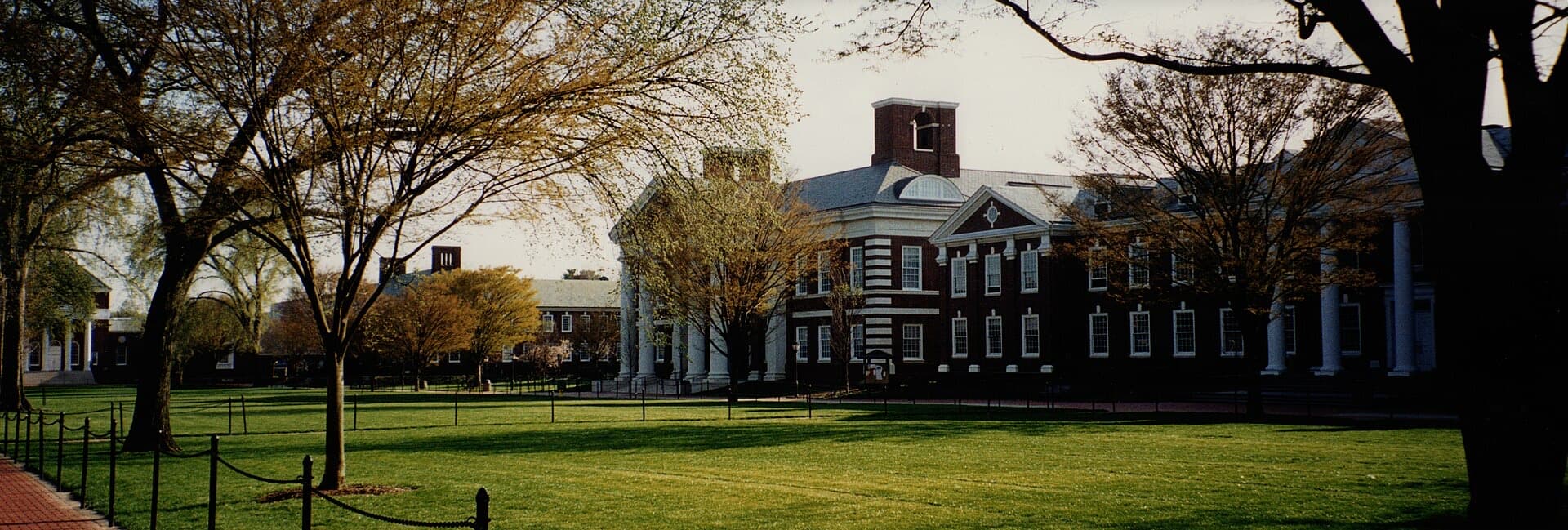

University of Delaware
The University of Delaware is a public research university in Newark, blending land-grant, sea-grant, and space-grant missions with a historic central Green that anchors its campus. Admission is moderately selective: about 69% of roughly 39,700 applicants are admitted, and enrolled first-years carry an average high school GPA near 3.98 with middle-50% SAT scores of 1220–1370. Two-thirds of undergraduates come from outside Delaware, drawn to strong programs in business, the health professions, and engineering, and a 92% first-year retention rate reflects how well students settle in once they arrive.
See how Delaware compares
Pick up to two rivals — or search any school.
Delaware admissions statistics
Acceptance rate
Overall acceptance rate, plus the in-state and out-of-state admit rates the school reports separately.
Admit rate by residency
% admittedEarly action
Delaware offers non-binding Early Action — an earlier decision with no commitment to enroll.
Standardized tests
Delaware is currently test-optional — you may apply without submitting scores.
SAT Accepted?
ACT Accepted?
Test Optional?
SAT Scores
ACT Scores
Writing your Delaware application essay?
Paste your draft and get specific, line-by-line feedback on what is and isn't landing — scored against the rubrics admissions readers use.
Class rank
Where Delaware's enrolled first-years placed in their high school graduating class.
Based on the 36.4% of enrolled students who reported a class rank. Delaware does not publish an average GPA.
Admissions factors
How Delaware weighs each part of your application.
Rigor of High School Record
Academic GPA
Standardized Test Scores
Application Essay
Recommendations
Extracurricular Activities
Character / Personal Qualities
Talent / Ability
First Generation
Level of Applicant's Interest
Class Rank
Volunteer Work
Work Experience
Geographical Residence
State Residency
Alumni Relation
Racial / Ethnic Status
Religious Affiliation
Cost of attendance
Estimated full-time annual cost from Delaware's Common Data Set. Only tuition changes with residency.
Financial aid
Need-based aid statistics for full-time first-year students.
Frequently asked questions about Delaware admissions
The University of Delaware admitted about 69.2% of applicants in the most recent cycle, drawing roughly 39,700 applications and enrolling around 4,100 first-year students. That makes UD moderately selective, though admission to the Honors College and a few competitive majors runs tighter than the overall rate suggests.
Admission to Delaware is achievable for a solid student but not a sure thing. Roughly 69% of applicants are admitted, and competitive candidates carry an average high school GPA near 3.98 with middle-50% SAT scores of 1220–1370. UD reviews applications holistically, weighing course rigor and GPA as very important factors.
Out-of-state applicants are admitted at nearly the same rate as Delaware residents. In the Fall 2024 cycle, UD admitted about 71% of in-state applicants and 70% of out-of-state applicants. Out-of-state students also make up about two-thirds of the undergraduate body, so applying from another state does not meaningfully lower your odds, even though state residency is listed as a very important factor.
Enrolled first-years average about a 3.98 high school GPA, and roughly 64% ranked in the top quarter of their graduating class. Academic GPA and the rigor of your course load are both weighed as very important factors, so strong grades in a challenging schedule matter more than any single cutoff.
A 1350 is competitive at Delaware. It sits in the upper half of enrolled students, just below the 75th-percentile mark of 1370. The middle 50% of first-years who submitted scores landed at 1220–1370 on the SAT and 28–32 on the ACT, so a 1350 puts you at or above a typical admitted student.
Yes, UD is test-optional, so you can apply without SAT or ACT scores. Only about 19% of enrolled first-years submitted the SAT and roughly 3% the ACT. If you choose to submit, scores are weighed as a considered factor, while GPA and course rigor carry more weight in the review.
Annual tuition and required fees come to about $17,660 for Delaware residents and $43,220 for out-of-state students. Around 59% of first-years receive need-based aid, with an average package near $20,474, and UD meets roughly 64% of demonstrated need on average. The First State Promise covers tuition and fees for eligible in-state students with financial need.
Yes. Delaware rates the application essay as an important factor in its holistic review, on par with recommendations and extracurriculars and above test scores, which are only considered. With grades and rigor carrying the most weight, a specific, well-revised essay is a real chance to add context and stand out.
Esslo gives free line-by-line feedback on your draft. Try it now
Popular majors
Bachelor's degrees awarded in the past year by academic major.
Student-faculty ratio
The number of students for every one faculty member, indicating the average level of access students have to instructional staff.
Campus life
On-campus housing and Greek life participation rates.
Enrollment by gender
Student diversity
Racial and ethnic breakdown of enrolled undergraduate students.
Source: University of Delaware Common Data Set 2024-2025. Figures transcribed 2026-06-22. Esslo aggregates publicly reported data and is not affiliated with Delaware. Banner photo by Parkpay2000, via Wikimedia Commons (CC BY-SA 3.0). Cite this page as: Esslo College Explorer, “University of Delaware admissions statistics, transcribed from the 2024-2025 Common Data Set,” https://www.esslo.org/colleges/university-of-delaware (retrieved 2026-06-22).