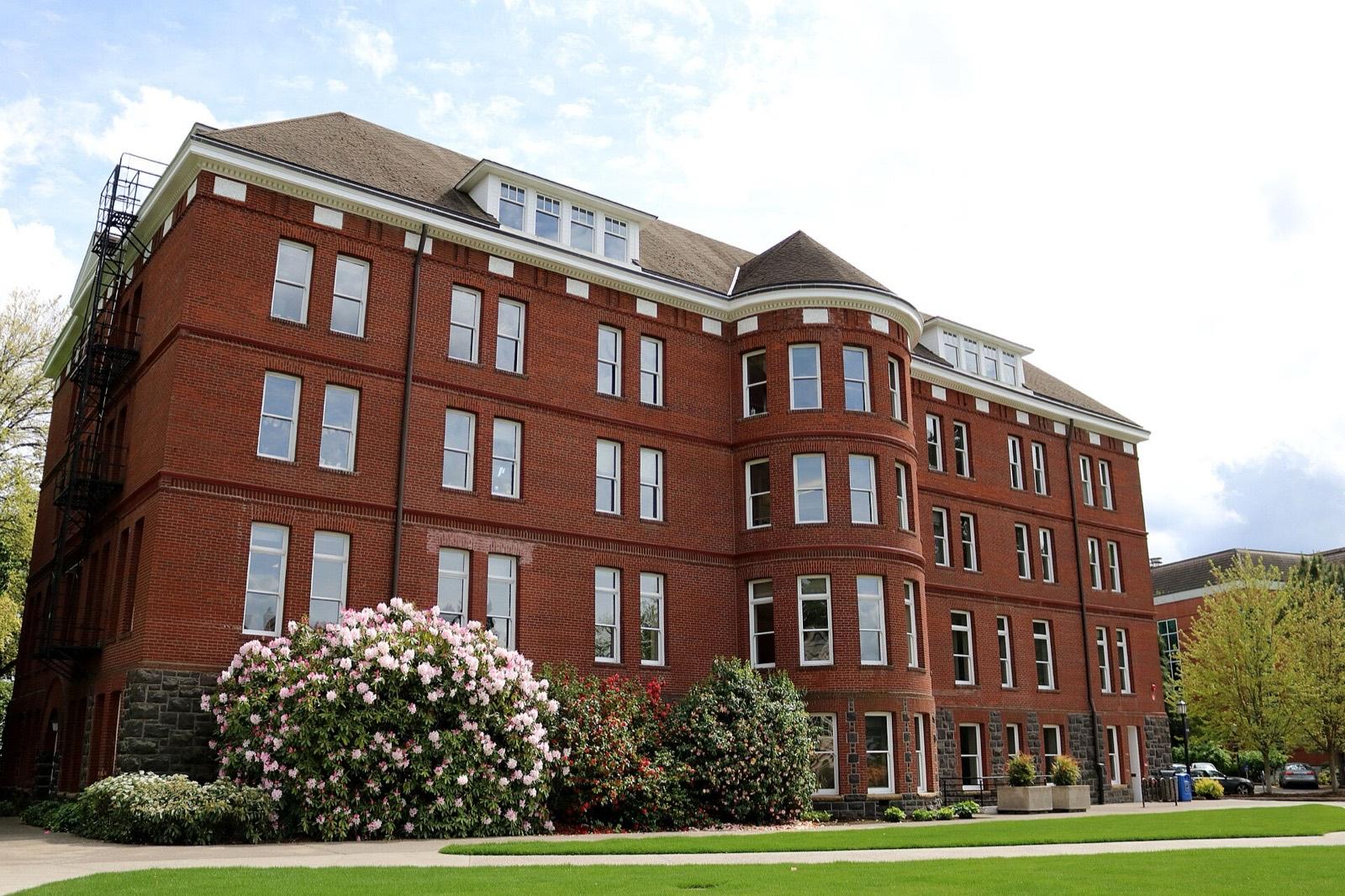

University of Portland
The University of Portland is a private Catholic university in North Portland, Oregon, founded in 1901 and affiliated with the Congregation of Holy Cross. It enrolls 2,814 undergraduates, and health professions, the category that includes nursing, account for 27% of its bachelor's degrees, followed by business at 15% and engineering at 10%. The university admitted 91.8% of first-year applicants for fall 2025, and enrolled first-years had an average high school GPA of 3.69. Tuition and required fees are $62,625, and first-years with financial need received an average aid package of $51,875.
See how University of Portland compares
Pick up to two rivals — or search any school.
University of Portland admissions statistics
Acceptance rate
Total applicants, admitted students, and enrolled students for the most recent admission cycle.
Early action
University of Portland offers non-binding Early Action — an earlier decision with no commitment to enroll.
University of Portland transfer acceptance rate
For fall 2025, University of Portland admitted 282 of 396 transfer applicants, for a transfer acceptance rate of 71.2%. University of Portland's transfer acceptance rate is lower than its first-year acceptance rate of 91.8% in the same Common Data Set. Of the admitted transfer applicants, 101 enrolled. The Common Data Set counts transfer applicants separately from first-year applicants.
The guide Is transferring colleges worth it? covers lost credits, financial aid and scholarships when you transfer.
Standardized tests
University of Portland is currently test-optional — you may apply without submitting scores.
SAT Accepted?
ACT Accepted?
Test Optional?
SAT Scores
ACT Scores
Writing your University of Portland application essay?
Paste your draft and get specific, line-by-line feedback on what is and isn't landing — scored against the rubrics admissions readers use.
Admissions factors
How University of Portland weighs each part of your application.
Rigor of High School Record
Academic GPA
Standardized Test Scores
Application Essay
Recommendations
Extracurricular Activities
Character / Personal Qualities
Talent / Ability
First Generation
Level of Applicant's Interest
Class Rank
Volunteer Work
Work Experience
Geographical Residence
State Residency
Alumni Relation
Racial / Ethnic Status
Religious Affiliation
Cost of attendance
Estimated full-time annual cost from University of Portland's Common Data Set.
Private universities charge the same tuition regardless of state residency.
What families actually pay
Average net price — what was left to pay after grant aid — for students receiving federal financial aid.
Source: College Scorecard (2026)
Financial aid
Need-based aid statistics for full-time first-year students.
Frequently asked questions about University of Portland admissions
No. The University of Portland admitted 7,054 of 7,686 first-year applicants for fall 2025, an acceptance rate of 91.8%. It rates the rigor of your high school courses and your GPA as very important, and enrolled first-years had an average high school GPA of 3.69.
Enrolled first-years at the University of Portland had an average high school GPA of 3.69. The university's Common Data Set does not list a minimum GPA. It rates academic GPA and the rigor of your high school courses as very important, and class rank as important.
Yes. The University of Portland does not require the SAT or ACT and considers scores if you submit them. Few students do: 4% of enrolled first-years submitted SAT scores and 1% submitted ACT scores. The middle 50% of those who submitted scored 1205–1325 on the SAT and 28–33 on the ACT.
Tuition and required fees at the University of Portland are $62,625 a year, and on-campus food and housing add $18,650. The university estimates another $1,140 for books and supplies, $484 for transportation and $1,390 for other expenses, which brings the total to $84,289.
The University of Portland awarded need-based grant aid to 60% of its full-time first-years. First-years with financial need who received aid got an average package of $51,875, and the university met 80% of their need on average.
Health professions, the category that includes nursing, make up 27% of the University of Portland's bachelor's degrees. Business follows at 15%, engineering at 10%, and biological sciences and psychology at 8% each. The student-faculty ratio is 10 to 1.
Yes. The University of Portland rates the application essay as important, the same rating it gives class rank, extracurricular activities, talent, volunteer work and work experience. Only course rigor and GPA rate higher, and test scores and recommendations rate lower, as considered.
Esslo gives free line-by-line feedback on your draft. Try it now
The University of Portland offers early action and does not offer early decision. Its early action plan is non-binding and non-restrictive, so you can apply early to other colleges and you do not have to commit if you are admitted.
For fall 2025, University of Portland admitted 282 of 396 transfer applicants, for a transfer acceptance rate of 71.2%. University of Portland's transfer acceptance rate is lower than its first-year acceptance rate of 91.8% in the same Common Data Set. Of the admitted transfer applicants, 101 enrolled. The Common Data Set counts transfer applicants separately from first-year applicants.
Popular majors
Bachelor's degrees awarded in the past year by academic major.
Student-faculty ratio
The number of students for every one faculty member, indicating the average level of access students have to instructional staff.
Student outcomes
Median yearly income of former students who received federal aid, across every major, measured four years after graduating (2017–18 and 2018–19 graduates, earnings measured 2022–2023). Debt covers federal loans of students who completed.
Source: College Scorecard (2026)
Programs
University of Portland’s most popular programs and median pay after graduation. Income data from the US Department of Education’s College Scorecard.
- Nursing
226 degrees (2023-24)
~$104kmedian pay, 4 yrs after graduation~$24k median debt - Biology
65 degrees (2023-24)
~$58kmedian pay, 4 yrs after graduation~$23k median debt - Psychology
51 degrees (2023-24)
~$51kmedian pay, 4 yrs after graduation~$21k median debt - Mechanical Engineering
50 degrees (2023-24)
~$93kmedian pay, 4 yrs after graduation~$15k median debt - Marketing
39 degrees (2023-24)
~$73kmedian pay, 4 yrs after graduation~$18k median debt
Show all 31 programsShow fewer
- Computer Science
33 degrees (2023-24)
~$126kmedian pay, 4 yrs after graduation~$20k median debt - Finance
32 degrees (2023-24)
Not publishedmedian pay after graduation - Teacher Education: Grade Levels
26 degrees (2023-24)
~$54kmedian pay, 4 yrs after graduation~$16k median debt - Environmental Science & Natural Resources
22 degrees (2023-24)
~$55kmedian pay, 4 yrs after graduation - Public Relations & Advertising
21 degrees (2023-24)
~$62kmedian pay, 4 yrs after graduation - Accounting
21 degrees (2023-24)
~$96kmedian pay, 4 yrs after graduation - Management Science & Quantitative Methods
21 degrees (2023-24)
~$84kmedian pay, 4 yrs after graduation~$23k median debt - English
18 degrees (2023-24)
~$49kmedian pay, 4 yrs after graduation~$18k median debt - Civil Engineering
16 degrees (2023-24)
~$89kmedian pay, 4 yrs after graduation~$20k median debt - Social Work
15 degrees (2023-24)
~$57kmedian pay, 4 yrs after graduation - Political Science
15 degrees (2023-24)
~$39kmedian pay, 1 yr after graduation - Electrical Engineering
13 degrees (2023-24)
~$106kmedian pay, 4 yrs after graduation - Sociology
12 degrees (2023-24)
~$46kmedian pay, 1 yr after graduation - Chemistry
11 degrees (2023-24)
Not publishedmedian pay after graduation~$22k median debt - Communication & Media Studies
8 degrees (2023-24)
Not publishedmedian pay after graduation - Health Sciences
8 degrees (2023-24)
Not publishedmedian pay after graduation - Economics
6 degrees (2023-24)
Not publishedmedian pay after graduation - Philosophy
5 degrees (2023-24)
Not publishedmedian pay after graduation - Mathematics
4 degrees (2023-24)
~$79kmedian pay, 4 yrs after graduation - Theatre
3 degrees (2023-24)
Not publishedmedian pay after graduation - Music
3 degrees (2023-24)
Not publishedmedian pay after graduation - Applied Mathematics
2 degrees (2023-24)
~$78kmedian pay, 4 yrs after graduation~$22k median debt - History
2 degrees (2023-24)
~$53kmedian pay, 4 yrs after graduation - Physics
2 degrees (2023-24)
Not publishedmedian pay after graduation - Biochemistry & Molecular Biology
1 degrees (2023-24)
Not publishedmedian pay after graduation - Romance Languages
Degrees conferred not published (2023-24)
~$54kmedian pay, 4 yrs after graduation
Median pay data is measured from graduates who received federal student aid.
Source: College Scorecard (2026) · IPEDS (2023-24)
Campus life
On-campus housing and Greek life participation rates.
Place
How the federal government classifies the area around the campus, and what a normal year of weather looks like there.
Average temperature
Monthly high and low, °FThirty-year averages, measured at the nearest weather station rather than on campus — they describe the area, not the campus.
Source: IPEDS (HD2024) · NOAA 1991–2020 U.S. Climate Normals, PORTLAND KGW-TV, OR US station, 4.2 mi from campus
Enrollment by gender
Student diversity
Racial and ethnic breakdown of enrolled undergraduate students.
Source: University of Portland Common Data Set 2025-2026. Figures transcribed 2026-11-21. Esslo aggregates publicly reported data and is not affiliated with University of Portland. Banner photo by Jgriffin094, via Wikimedia Commons (CC BY-SA 4.0). Cite this page as: Esslo College Explorer, “University of Portland admissions statistics, transcribed from the 2025-2026 Common Data Set,” https://www.esslo.org/colleges/university-of-portland (retrieved 2026-11-21).