
University of San Diego
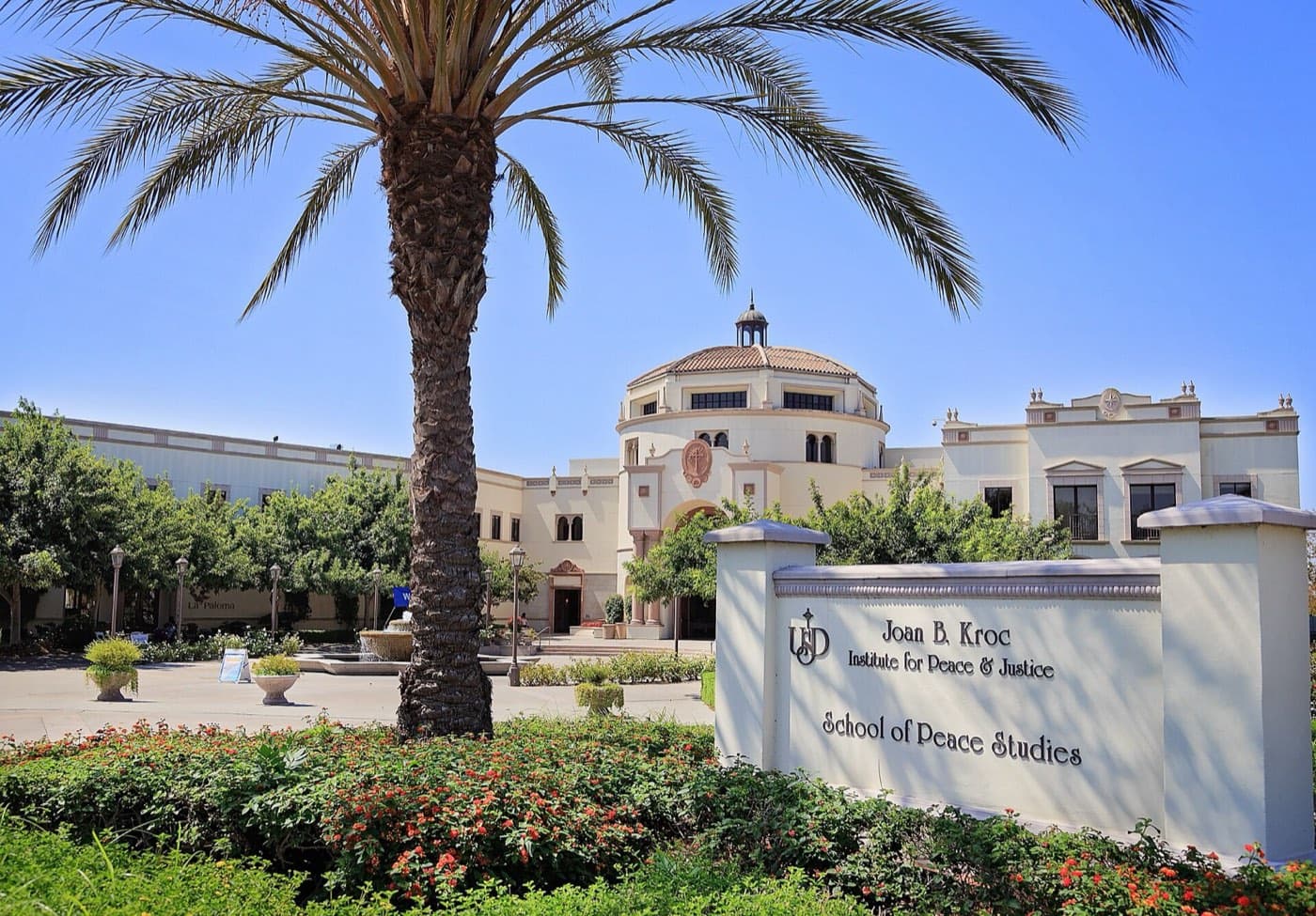
The University of San Diego occupies a hilltop in Alcalá Park, and its Spanish Renaissance campus looks out over Mission Bay and the Pacific. USD dropped standardized tests entirely in 2020 and now reads applications test-free, meaning it will not look at an SAT or ACT score even if you send one. Business drives the academic profile at roughly 40% of bachelor's degrees, with the Kroc School of Peace Studies giving the Catholic university an unusual second identity in conflict resolution and social justice. Admitted first-years average a 4.02 GPA, about 53.6% of applicants get in, and nearly a third of undergraduates are Hispanic.
See how University of San Diego compares
Pick up to two rivals — or search any school.
University of San Diego admissions statistics
Acceptance rate
Total applicants, admitted students, and enrolled students for the most recent admission cycle.
Early decision
University of San Diego offers binding Early Decision. Applying early can meaningfully change your odds — but ED commits you to enroll if admitted.
Standardized tests
University of San Diego is test-free — SAT and ACT scores are not considered in admissions.
SAT / ACT scores are not used
University of San Diego does not review SAT or ACT scores for admission, even if you submit them. Applicants are evaluated on GPA, coursework, essays, and activities instead.
University of San Diego supplemental essays — 2026-2027 cycle
How did you first learn about the University of San Diego, and what inspired you to apply?
USD is committed to fostering a community where everyone feels a sense of belonging and purpose. Reflecting on your own experiences, what does community mean to you? How have you helped create inclusive, welcoming spaces for others, and what have you learned from those efforts?
What is a challenge facing humanity today and why does it matter to you?
As a contemporary Catholic university, students from all backgrounds and faith traditions are welcomed and celebrated. Share an experience that highlights the ways faith or spirituality–either your own or someone else’s–have influenced your life.
Writing your University of San Diego application essay?
Paste your draft and get specific, line-by-line feedback on what is and isn't landing — scored against the rubrics admissions readers use.
Class rank
Where University of San Diego's enrolled first-years placed in their high school graduating class.
Based on the 30% of enrolled students who reported a class rank. University of San Diego does not publish an average GPA.
Admissions factors
How University of San Diego weighs each part of your application.
Rigor of High School Record
Academic GPA
Standardized Test Scores
Application Essay
Recommendations
Extracurricular Activities
Character / Personal Qualities
Talent / Ability
First Generation
Level of Applicant's Interest
Class Rank
Volunteer Work
Work Experience
Geographical Residence
State Residency
Alumni Relation
Racial / Ethnic Status
Religious Affiliation
Cost of attendance
Estimated full-time annual cost from University of San Diego's Common Data Set.
Private universities charge the same tuition regardless of state residency.
What families actually pay
Average net price — what was left to pay after grant aid — for students receiving federal financial aid.
Source: College Scorecard (2026)
Financial aid
Need-based aid statistics for full-time first-year students.
Frequently asked questions about University of San Diego admissions
USD admits about 53.6% of applicants, which puts it in the moderately selective range. It received roughly 17,470 applications and enrolled 1,300 first-years in the most recent cycle. Grades do the heavy lifting: admitted students average a 4.02 GPA, and USD rates course rigor and academic GPA as its only two very important factors.
No. USD is test-free, not test-optional, which means admissions readers do not consider an SAT or ACT score even if you submit one. Its Common Data Set confirms this: standardized test scores are marked 'not considered,' and the score tables are blank because USD collects nothing to report. Spend that energy on your transcript and essays instead.
Enrolled first-years average a 4.02 weighted GPA. Among the 30% who reported a class rank, 76% sat in the top quarter of their graduating class and 96% in the top half. With no test scores in the file, your transcript carries more weight at USD than at most schools, and the rigor of the courses behind that GPA is rated equally important.
Tuition and required fees total $65,199 a year, plus $19,200 for on-campus food and housing. About 57% of first-years receive need-based scholarship or grant aid, the average first-year package reaches $61,010, and USD covers roughly 85% of demonstrated need. Merit scholarships also go to a meaningful share of admitted students who show no financial need.
USD offers both a binding Early Decision round and a non-binding, non-restrictive Early Action round, so you can apply early without committing if you prefer. The university publishes no early-round application or admit counts in its Common Data Set, so the size of any early advantage is not documented. Early Decision does signal commitment at a school that reads applications holistically.
Business and marketing lead by a wide margin at about 40% of bachelor's degrees. Biological sciences follow at 12%, then social sciences at 9% and engineering at 8%. Psychology and communication round out the top six at 7% and 6%, and USD's peace studies and nursing programs draw students well beyond their share of degrees conferred.
It is a real presence without dominating campus. About 13% of undergraduate men join fraternities and 21% of women join sororities. Housing shapes social life more: 94% of first-years live in university housing, and about half of all undergraduates stay on campus, which keeps activity centered on Alcalá Park rather than off-campus chapter houses.
Yes, and more than usual, because USD ignores test scores entirely. The university rates the application essay as an important factor alongside recommendations, activities, character, and volunteer work. With one fewer quantitative signal in the file, your writing carries a larger share of what admissions readers learn about you.
Esslo gives free line-by-line feedback on your draft. Try it now
Popular majors
Bachelor's degrees awarded in the past year by academic major.
Student-faculty ratio
The number of students for every one faculty member, indicating the average level of access students have to instructional staff.
Student outcomes
Median yearly income of former students who received federal aid, across every major, measured four years after graduating (2017–18 and 2018–19 graduates, earnings measured 2022–2023). Debt covers federal loans of students who completed.
Source: College Scorecard (2026)
Programs
University of San Diego’s most popular programs and median pay after graduation. Income data from the US Department of Education’s College Scorecard.
- Finance
147 degrees (2023-24)
~$93kmedian pay, 4 yrs after graduation~$23k median debt - Business Administration & Management
122 degrees (2023-24)
~$80kmedian pay, 4 yrs after graduation~$20k median debt - Psychology
99 degrees (2023-24)
~$74kmedian pay, 4 yrs after graduation~$23k median debt - Communication & Media Studies
73 degrees (2023-24)
~$69kmedian pay, 4 yrs after graduation~$24k median debt - Neuroscience
70 degrees (2023-24)
~$73kmedian pay, 4 yrs after graduation~$25k median debt
Show all 23 programsShow fewer
- Biology
68 degrees (2023-24)
~$60kmedian pay, 4 yrs after graduation~$23k median debt - Political Science
67 degrees (2023-24)
~$62kmedian pay, 4 yrs after graduation~$25k median debt - Computer Science
53 degrees (2023-24)
~$150kmedian pay, 4 yrs after graduation~$20k median debt - Mechanical EngineeringABET accreditedMechanical Engineering is accredited by ABET, the accreditor for engineering, computing, and applied science programs.
42 degrees (2023-24)
~$92kmedian pay, 4 yrs after graduation~$26k median debt - Environmental Science & Natural Resources
39 degrees (2023-24)
~$59kmedian pay, 4 yrs after graduation~$23k median debt - Electrical EngineeringABET accreditedElectrical Engineering is accredited by ABET, the accreditor for engineering, computing, and applied science programs.
32 degrees (2023-24)
~$110kmedian pay, 4 yrs after graduation~$29k median debt - Industrial EngineeringABET accreditedIndustrial and Systems Engineering is accredited by ABET, the accreditor for engineering, computing, and applied science programs.
18 degrees (2023-24)
~$81kmedian pay, 1 yr after graduation - English
18 degrees (2023-24)
~$69kmedian pay, 4 yrs after graduation~$24k median debt - General EngineeringABET accreditedEngineering is accredited by ABET, the accreditor for engineering, computing, and applied science programs.
15 degrees (2023-24)
Not publishedmedian pay after graduation - Fine & Studio Arts
14 degrees (2023-24)
Not publishedmedian pay after graduation - Biochemistry & Molecular Biology
12 degrees (2023-24)
~$83kmedian pay, 4 yrs after graduation~$27k median debt - Economics
12 degrees (2023-24)
Not publishedmedian pay after graduation - History
10 degrees (2023-24)
Not publishedmedian pay after graduation - Philosophy
6 degrees (2023-24)
Not publishedmedian pay after graduation - Chemistry
6 degrees (2023-24)
Not publishedmedian pay after graduation - Mathematics
3 degrees (2023-24)
Not publishedmedian pay after graduation - Music
3 degrees (2023-24)
Not publishedmedian pay after graduation - Physics
2 degrees (2023-24)
Not publishedmedian pay after graduation
Median pay data is measured from graduates who received federal student aid.
Source: College Scorecard (2026) · IPEDS (2023-24) · ABET
Campus life
On-campus housing and Greek life participation rates.
Place
How the federal government classifies the area around the campus, and what a normal year of weather looks like there.
Average temperature
Monthly high and low, °FThirty-year averages, measured at the nearest weather station rather than on campus — they describe the area, not the campus.
Source: IPEDS (HD2024) · NOAA 1991–2020 U.S. Climate Normals, NORTH ISLAND NAS, CA US station, 4.9 mi from campus
Enrollment by gender
Student diversity
Racial and ethnic breakdown of enrolled undergraduate students.
Source: University of San Diego Common Data Set 2025-2026. Figures transcribed 2026-08-19. Esslo aggregates publicly reported data and is not affiliated with University of San Diego. Banner photo by Krdobyns, via Wikimedia Commons (CC BY-SA 4.0). Cite this page as: Esslo College Explorer, “University of San Diego admissions statistics, transcribed from the 2025-2026 Common Data Set,” https://www.esslo.org/colleges/university-of-san-diego (retrieved 2026-08-19).