How to Go From Community College to a UC
A step-by-step guide

Sia Bedi
January 30, 2026
Planning to transfer to a UC? Transferring from a California Community College (CCC) to a University of California (UC) campus is one of the most strategic paths into top public universities, such as UCLA, UC Berkeley, and UCSD, among others. If you plan it right, community college is a great pathway into UCs.

What Does “Transferring to a UC” Actually Mean?
A transfer student is someone who starts college at one institution, then moves to another institution to finish their bachelor’s degree.
When you transfer to a UC:
- You do not start over.
- You enter as a junior or 3rd-year student.
- You complete upper-level coursework or advanced major classes.
The UCs expect transfer students to be academically prepared, which is why their requirements are clear and strict.
What Is a California Community College (CCC)?
A California Community College (CCC) is a public, two-year college funded by the state of California. There are 116 CCC campuses across California, and they are designed to provide affordable education, prepare students for transfer to 4-year universities, and train students for the workforce.
What does this mean for UC transfers? CCCs are special because UCs tend to prioritize CCC students over out-of-state or private college transfers. In addition, CCC coursework is already pre-approved and standardized for UC transfer. This is why starting at a CCC is not a disadvantage, but actually a preferred pathway.
What Counts Towards UC-Transferable Units?
A unit (also called a credit) measures how much a class is worth. Most college classes are worth 2-5 units.
A class is UC-transferable if:
- The UC system has approved it.
- It can count towards the 60-unit requirement.
- It applied to general education or major prep.
But not all classes are transferable, such as:
- Remedial math or English
- Some vocational or skills-based courses (Automotive technology, Welding, etc.)
- Certain personal development classes
Taking non-transferable classes can slow your transfer timeline, so make sure to plan early.
The 60 UC-Transferable Semester Units Requirement
To transfer to a UC, you must complete 60 UC-transferable semester units by the end of spring before you enroll. A bachelor’s degree is 120 units total. Therefore, completing 60 units at a CCC takes care of lower-division coursework, and the remaining 60 units will account for upper-division coursework at the UC you enroll in. UC’s do not admit students with fewer than 60 units because they are not prepared to begin upper-division study.
Students usually reach their 60 units by completing 15 units per semester for 4 semesters (which is the standard two-year plan)
Using ASSIST.org: What It Is and Why It’s Crucial
Assist.org is the official database that shows which community college courses transfer to UCs, which courses satisfy major requirements, and course-to-course equivalencies between schools. Admission officers use ASSIST to evaluate your application. If a course is not listed on ASSIST, a UC may not accept it, even if your counselor says that it should be fine. ASSIST is a policy that the UCs and admissions officers must follow.
The Purpose of IGETC
IGETC stands for Intersegmental General Education Transfer Curriculum
“The Intersegmental General Education Transfer Curriculum (IGETC) is a series of courses that California community college students can complete to satisfy most freshman/sophomore-level general education requirements before transferring to UC.” (UC Admissions)
IGETC is a package of General Education courses. General Education (GE) courses are classes that are not specific to your major and build foundational skills, such as History, Philosophy, Biology, Sociology, Literature, etc.
IGETC is a package of GE courses that are completed at a community college and are accepted by UC campuses. By completing IGETC, most of your lower-division GE is finished.
IGETC is great for many majors, but not exactly recommended for some STEM and highly structured majors. To learn more about STEM-specific IGETC requirements, click this link.
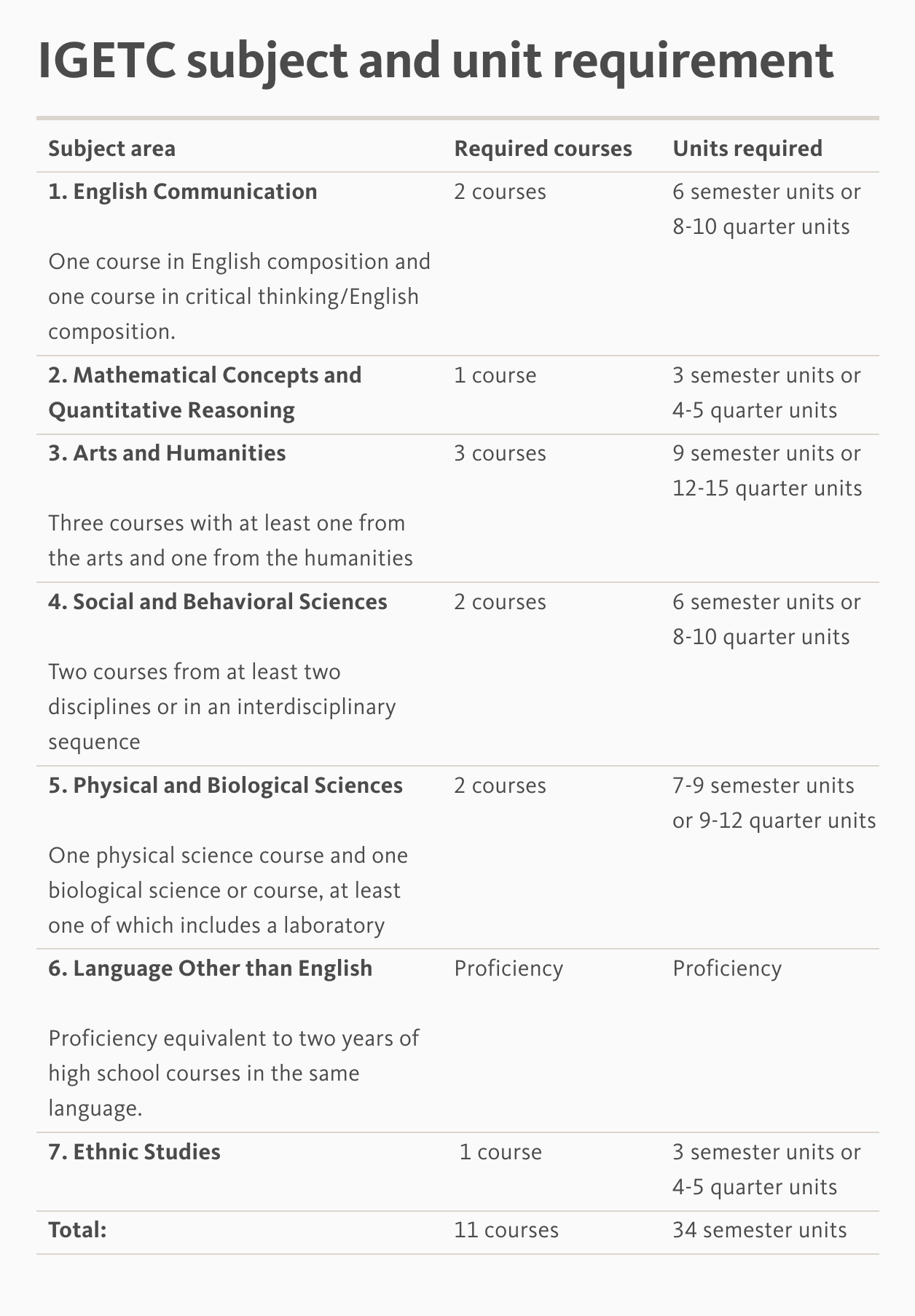
The 7 Course Pattern: UC’s Minimum Academic Core
All UC transfer applicants must complete the 7-course pattern, regardless of major.
Major Preparation: What it Really Means
Major prep refers to the required lower-division courses for your intended major and courses that prepare you for advanced study. These are usually math, science, statistics, and introductory theory courses. For competitive majors, major prep matters more than GE.
Missing a required prep class can lower your chances of acceptance, delay graduation, and make you ineligible for certain campuses.
TAG: Transfer Admission Guarantee
TAG is a formal agreement between you, your community college, and a UC campus. It guarantees admission if you meet all conditions.
TAG requirements usually include a minimum GPA, which varies by campus and major, completion of required coursework, and no missing prerequisites. For TAG, applicants must apply in September, then apply to a UC later. TAG is powerful because it acts as a safety net and lets you apply to reach schools confidently.
To help plan your coursework online, UC TAP is a great tool that tracks your courses, shows UC your academic intent, and links directly to your UC Application. Using UC TAP shows a serious intent to transfer and organization.
Here are the exact steps outlined by the University of California:
1. Choosing your campus
Before you apply, figure out where you want to go. Check out our TAG matrix for a full list of the campuses in the program and their individual requirements.
2. Complete your TAG application
Use our Transfer Admission Planner to fill out your TAG application. If you have a community college counselor, review it with them. Don’t worry if you don’t—we have our own UC TAG advisors who can help you out. You’ll need to submit by September 30th for the fall term, or May 31st for the winter/spring term. Remember, if you miss the TAG deadline, you can still apply to UC during the regular application period, October 1 - December 1, for fall 2026 applicants.
3. Fulfill all your requirements
Once your application’s submitted, you’ll need to complete all your remaining coursework and hit the GPA requirements in your TAG agreement.
4. Submit your UC application
When you’re on track for all of the above, fill out the application for admission to UC. Make sure you submit your application between October 1 and December 1 for the fall term and between July 1 and 31 for the winter/spring term.
How to Write Personal Insight Questions (PIQs)
PIQs are short essays that are a part of the UC Application. PIQs allow you to explain your background, show growth and self-awareness, and add content to your transcript. Transfers often have stronger PIQs because they bring work experience, responsibility, and clear academic goals. By using Esslo.org, applicants can see how their essay ranks against others and get free, instant feedback in the matter of five minutes.
Community college is a proven pathway that thousands of students use every year to earn UC degrees. With the right planning and understanding, that pathway can be yours too.